
Search changed faster than most law firm websites did.
This one was no exception.
The website was outdated, easy to overlook, and no longer built for the way legal search works today. RedBlink stepped in to rebuild the AI SEO foundation and help the site compete in a more demanding search environment shaped by AI-generated answers, zero-click behavior, local intent, and stronger expectations around helpful, trustworthy content and topical authority.
What follows is the story of that shift — from an aging legal website to a stronger digital asset built for modern search and a more resilient attorney AI SEO strategy.
Client Background

At first glance, this may look like a typical law firm website project.
It is not.
This is a Los Angeles real estate law firm serving clients across real estate disputes, commercial and residential property matters, and related litigation issues. The practice has real legal depth and operates in a market where search visibility is shaped by competition, local intent, and trust.
Client Snapshot
- Client type: Real estate law firm
- Location: Los Angeles
- Practice focus: Real estate disputes, commercial and residential property matters, and related litigation work
- Search environment: Competitive legal SERPs, AI Overviews & LLMss with strong local intent
- Core need: A website that reflects the depth and clarity of the practice more effectively in search
Attorney AI SEO for a real estate law firm is more layered than broad legal AI SEO. A firm like this needs to show relevance across multiple search intents at once, from property disputes and title issues to commercial real estate matters and other location-sensitive legal searches. That is what made this project more complex than a standard law firm AI SEO engagement.
It also meant the site had to support the kind of signals modern search engines use to evaluate helpful, people-first content and what Google describes through broader search quality and relevance signals. In a niche like real estate law, that usually requires stronger topical coverage, clearer service intent, and a website structure that helps both users and search engines understand the full scope of the practice.
The AI SEO Challenges Before RedBlink

The firm had the legal experience. The website did not have the search foundation to match it.
When RedBlink began working on the site, the AI SEO starting point was weak. The website had limited onsite AI SEO, low visible keyword reach, no meaningful local AI SEO base, and little prior digital marketing momentum. It was also smaller than many competing legal websites, which made it harder to gain traction in a crowded market.
What the Website Was Up Against?
- Limited onsite AI SEO – Key pages were not giving search engines clear enough signals about relevance, structure, or service focus.
- Weak keyword visibility – The site was not showing up strongly for the types of searches that could bring in qualified real estate law inquiries.
- No strong local AI SEO base – That created a major disadvantage in a legal niche where local intent often shapes who gets shortlisted. A well-managed Google Business Profile and stronger local relevance signals are often important in this kind of search environment.
- A smaller website in a competitive market – Competing firms often had broader content coverage and a stronger digital footprint.
- Heavy competition – The firm was operating in a crowded legal search environment where visibility was already hard to win.
Together, these issues made it harder for the website to communicate the firm’s relevance, authority, and service depth in search. That was the gap RedBlink needed to close.
What RedBlink Changed to Improve Search Visibility?

Once the gaps were clear, the work moved from observation to execution.
This was not a project where generic legal copy or surface-level AI SEO edits would be enough. Real estate law is too nuanced for that. The client understood the business, the legal services, and the language their market uses. So instead of forcing artificial content into the site, RedBlink asked the client to provide service-specific input and business context. That gave the project a stronger factual base from the start.
From there, RedBlink turned that raw business knowledge into search-ready assets.
How the collaboration worked?
- The client provided service knowledge, legal context, and business-specific details
- RedBlink mapped that input to search intent, page structure, metadata, and keyword variation
- The content was then strengthened with onsite AI SEO improvements, internal linking, and clearer topical relationships across the site
That approach mattered because strong rankings do not come from keywords alone. They come from building pages that reflect real expertise, satisfy intent clusters, and reinforce the topical connections search engines use to evaluate relevance.
What RedBlink worked on?
- Page-by-page onsite AI SEO improvements – Core pages were refined to send clearer relevance signals around the firm’s services, practice areas, and market focus.
- Service-page support and expansion – The site was strengthened with better service coverage so key legal topics could be understood more clearly in search.
- Metadata and keyword variation work – Important pages were aligned with stronger query targeting, better topical precision, and wider search-term coverage.
- Content refinement using client-provided business knowledge – The client supplied the core service understanding. RedBlink shaped that material into content that was easier for search engines to interpret and easier for prospects to trust.
- Blog and supporting content updates – Supporting pages were improved to help strengthen the broader topic graph around the firm’s core services and improve the site’s overall content strategy.
- Internal linking improvements – Relevant pages were connected more deliberately so authority could flow more effectively and service relationships became easier for search engines to process.
Why this approach worked?
The goal was not just to “optimize pages.”
The goal was to improve retrieval value.
That meant making the site easier to interpret at multiple levels: page level, topic level, and sitewide level. RedBlink focused on strengthening topical coverage, reducing ambiguity across service pages, and improving the semantic pathways between core and supporting content. This helped the site communicate expertise more clearly in traditional search and made it better positioned for search environments influenced by AI summaries, entity understanding, and answer-driven discovery.
In other words, the work was designed to help the website compete in both familiar SERPs, AI Overviews & LLMss and newer search experiences where search engines increasingly reward structure, clarity, contextual depth, and trust.
Results That Still Matter in AI and Traditional Search
These results came before AI-driven search experiences became a larger part of how users discover legal services online.
That is exactly why they still matter.
The growth shown below was not driven by short-term spikes or isolated ranking wins. It came from improving the site’s AI SEO foundation, strengthening service-page relevance, expanding topical coverage, and creating clearer internal relationships across the website. Those signals still matter today, whether a law firm is competing in traditional search results, local search, or AI-influenced search journeys.
1. Organic Traffic Growth
When RedBlink began working on the website, organic traffic stood at 3,151 monthly visits.
After sustained AI SEO improvements, that number reached 18,675 monthly visits by August 2022.
This increase did more than lift visibility. It showed that the website was becoming easier to discover for relevant legal searches and more competitive across a wider set of real estate law queries.
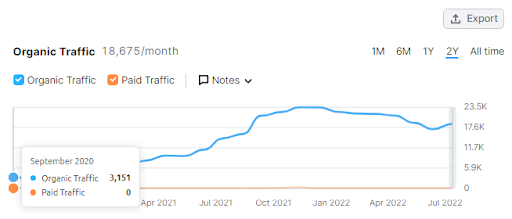
Before AI SEO: 3,151 monthly organic visits
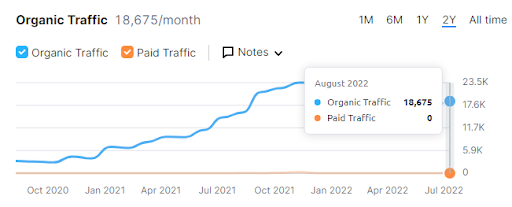
After AI SEO: 18,675 monthly organic visits
What this means today?
Traffic alone is no longer the full story.
But strong organic traffic growth still signals something important. It usually means the website has become more relevant, more discoverable, and better aligned with the way search engines interpret service-focused content. In today’s search environment, that kind of foundation helps a law firm compete across more than one type of search surface. It supports visibility in standard rankings, strengthens local search presence, and improves the site’s ability to earn attention in answer-driven search experiences.
2. Organic Keyword Growth
Traffic was only one part of the shift.
The broader signal was keyword footprint.
At the start of the engagement, the website ranked for 3,297 organic keywords. By August 2022, that total had grown to 20,683 keywords.
That matters because keyword breadth usually reflects stronger topical coverage. It suggests the site is no longer relying on a small group of pages or a narrow set of phrases. Instead, it is becoming more relevant across a wider search ecosystem tied to the firm’s services, related legal topics, and local-market intent.
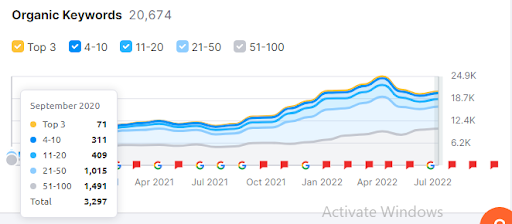
Before AI SEO: 3,297 ranking keywords
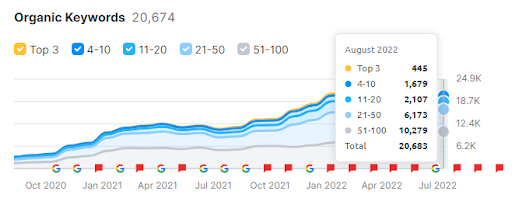
After AI SEO: 20,683 ranking keywords
Representative Page 1 Keyword Wins
The broader traffic and keyword growth shown above was supported by stronger visibility across commercially relevant search terms tied to the firm’s real estate law services.
Some of the page 1 keyword improvements included search terms related to:
- real estate disputes
- property disputes
- real estate attorney queries
- commercial real estate legal matters
- residential property dispute terms
- other high-intent local real estate law searches
These rankings helped expand the website’s visibility across the kinds of searches more likely to bring in qualified legal prospects.
Why this matters now?
In a modern SERPs, AI Overviews & LLMs, broader topic coverage matters more than isolated rankings.
A larger and more relevant keyword footprint gives a law firm website more ways to be discovered. It improves visibility across multiple search paths, supports more service intents, and helps build stronger overall authority around the practice. That matters not only for traditional rankings, but also for search environments that rely more heavily on entity understanding, contextual relevance, and answer-style discovery.
What These Results Show?
These charts matter for more than one reason.
The traffic increase shows that the website became easier to discover in search. The keyword growth shows that the site gained broader topical reach. Together, those signals point to something more valuable than vanity metrics: a stronger search presence built on clearer relevance, better service alignment, and more complete topic coverage.
That is what newer prospects should pay attention to.
Search behavior has changed. AI summaries, answer-first search experiences, and zero-click behavior have made it harder to measure progress through clicks alone. But the websites most likely to perform well in this environment are still the ones with stronger topical organization, better page relationships, clearer service intent, and more trustworthy content foundations.
This case study shows that RedBlink was not just improving rankings for the moment. It was building the kind of search foundation that continues to matter as search evolves.
Want stronger visibility for your law firm in AI and traditional search? Book a strategy call with RedBlink or fill out our contact form to discuss an AI SEO strategy tailored to your practice areas, market, and lead goals.
Estimate the ROI of Your Law Firm AI SEO Strategy
FAQs About Choosing an AI SEO Partner for a Law Firm
1. How is AI SEO for a law firm different from AI SEO for other local businesses?
Law firm AI SEO has higher trust requirements, stronger local intent, and more competitive search results. A good AI SEO partner should understand legal search behavior, practice-area targeting, and the trust signals that influence visibility in sensitive service categories.
2. Why do many law firms struggle to get results from AI SEO agencies?
Many firms get generic AI SEO work instead of a strategy built around their practice areas, local market, and client intent. When the agency does not understand the legal niche, the site may gain traffic but still fail to attract qualified consultations.
3. What should a law firm look for in an AI SEO partner?
A law firm should look for proven case studies, clear reporting, local AI SEO experience, strong content strategy, and an understanding of legal search intent. The right partner should also explain how they improve visibility, not just promise rankings.
4. Can a smaller law firm compete online against larger firms?
Yes, if the AI SEO strategy is focused. Smaller firms can compete by building stronger practice-area relevance, better local AI SEO signals, clearer service-page structure, and more useful content around the legal problems their clients actually search for.
5. How important is local AI SEO for attorneys?
Local AI SEO is critical because many legal searches are location-based. Prospects often look for attorneys in their city or region, compare multiple firms, and act quickly. Strong local visibility helps a firm appear in the search moments that are closest to conversion.
6. Why does legal website content need input from the client or attorney?
The best legal AI SEO content usually starts with real business and service knowledge. Attorneys and firms understand the legal issues, client questions, and service details better than any outside writer. A strong AI SEO partner uses that knowledge to create clearer, more search-ready content.
7. Is ranking for more keywords enough to judge AI SEO success for a law firm?
No. More rankings only matter if they improve visibility for relevant searches tied to the firm’s services. The real goal is better discovery for qualified legal intent, stronger practice-area coverage, and more opportunities for consultations from the right audience.
8. How long does it take for law firm AI SEO to show meaningful results?
AI SEO usually takes time because legal search is competitive and trust-based. Early improvements may appear within a few months, but stronger gains often come from consistent work on site structure, local relevance, service pages, internal linking, and content quality over time.
9. What are the warning signs that a law firm’s AI SEO strategy is too shallow?
Warning signs include vague reporting, too much focus on vanity metrics, weak local visibility, thin service pages, little internal linking, and content that sounds generic instead of specific to the firm’s actual legal services and market.
10. Why does AI SEO still matter for law firms in AI-driven search?
AI SEO still matters because AI-driven search depends on strong source content, clear topical coverage, and trustworthy website signals. A law firm website that is well-structured and service-specific has a better chance of being discovered across traditional search, local results, and newer answer-style search experiences.