
Last Updated on June 15, 2026
Threats can be innocuous. They appear unassuming at first, especially when orchestrated gradually. An unusual login attempt. A compromised database you zeroed down to a server error.
Or, in parallel, people with criminal intent who manage to enter into a communal setting with weapons. Workers who get injured in the workplace due to preventable factors.
Sadly, many of us awaken to the reality and seriousness of threats only after they manifest around us. Until then, systems remain on autopilot, reviews and audits are missed, and updates are ignored.
Recently, the 2026 ENISA Threat Landscape (European Union Agency for Cybersecurity) report found that ransomware remains the most impactful threat. However, DDoS attacks account for more than 75% of the reported incidents.
In the offline world, the picture is hardly better. The International Labor Organization warns that more than 2.9 million workers die annually because of work-related factors. Many of these factors are connected to fatal injuries from equipment. Better monitoring and early hazard detection may mitigate some of these concerns.
These are times of exponentially rising AI capabilities and influence. It would be a pity not to leverage the strengths of these emerging technologies to improve this scenario.
Drawing Insights From Multiple Sources In a Blink
In the rapidly interconnected world we live in, failing to consider multiple data sources to identify possible threats can be a huge limitation.
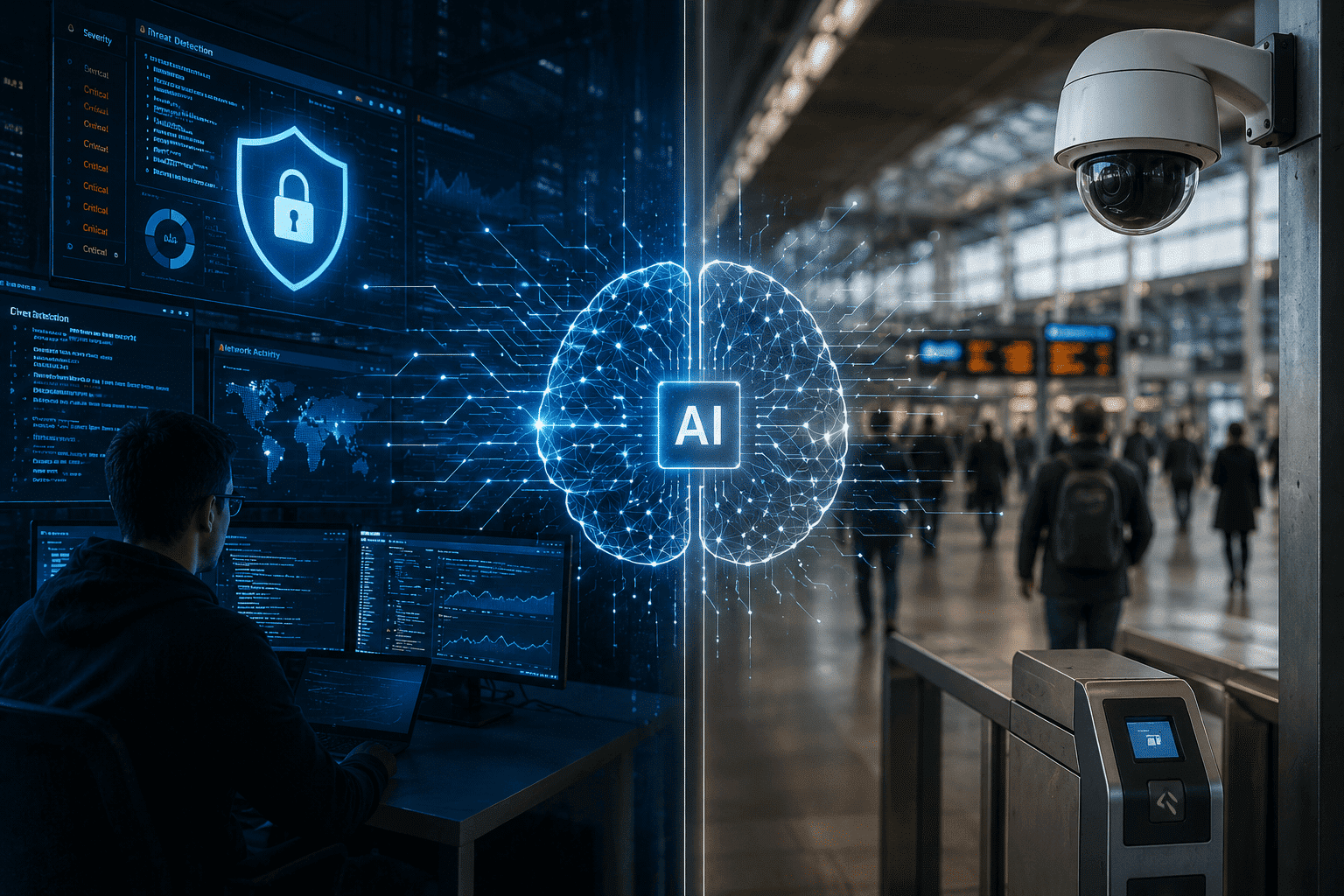
Consider a cybercrime situation. Early, subtle signs can come from user behavior or endpoint activity. It can also come from cloud logs. Similarly, in a physical scenario, such as at an airport, threat indications can come from not only cameras but also environmental sensors.
While human monitoring can analyze individual data streams, AI-based technologies can examine multiple data sources in parallel. The probability of error is likely to be much lower when compared to similar activities under human surveillance.
When faced with multiple alerts, we tend to enter a state of fatigue, even if it is subconscious. For example, a hospital surveillance team must deal with large volumes of health data. Handling alerts related to significant events amid this daily work can become challenging. But cutting corners in alertness can mean that an outbreak goes unnoticed.
According to the Association for the Advancement of Artificial Intelligence, AI ranking can help reduce this alert fatigue. A human-in-the-loop AI system can conduct monitoring using a ranking-based AI method for anomaly detection.
One important precaution here is the need for verification. Many experts assert that while AI systems are now more capable, verifying these outputs is getting daunting. Filling this gap between verification and automation will be essential for security systems we can truly depend on.
“If we do not invest in verification, we’re accumulating hidden risk. It is technical debt accumulating behind the scenes, and, at some point, it’ll come due.” – Christian Catalini, Research Scientist, MIT Sloan School of Management.
Unknown Threats Less Likely To Go Unnoticed
Another strength of AI security systems is their ability to detect unknown threats in both digital and physical spaces. These threats aren’t any the setting has encountered before. And yet, artificial intelligence can detect and manage them in real-time with arguably greater prowess than may be possible through human means alone.
For example, suppose a system finds an unusual login location. A typical cybersecurity system will likely flag it based on repeated encounters. With AI, we can perform real-time monitoring to ensure that this doesn’t amount to suspicious behavior or a possible hacking attempt.
In physical spaces, too, such advanced systems can work optimally for buildings that need high security. The objective is to maximize threat detection while lowering the incidence of false alarms.
Many establishments, such as hospitals and event venues, are moving toward a hybrid approach. They combine smart software solutions with top-notch conventional security, delivered through trained personnel.
Let us take an example. Nowadays, many businesses opt for walk-through metal detector installations that offer high-speed throughput and don’t flag personal items. This can lower the rate of false alerts.
At the same time, such solutions must also be stringent enough for the needs of airports and government facilities. GXC Inc. recommends ensuring alignment with the standards set by the National Institute of Justice (NIJ).
Now consider a building with advanced metal detectors and an AI-incorporated access control system. Together, these systems create new layers of protection, reducing dependency on just one screening mechanism. It can be a reassuring strategy to combine robust physical security with technology for trustworthy coverage.
From Detecting to Predicting
Imagine the volume of cyberattacks we could prevent if only we could predict and preempt them. Through predictive analytics, AI can support the development of this facet of security.
One way it does this is by liaising with global threat databases. This helps the system to predict possible attacks and block suspicious users or access attempts preemptively.
Even in a physical setting, AI-based security can predict potential environmental hazards and sound off an alarm. This could be from intelligence derived from an IoT sensor that reports unnatural levels of heat or humidity.
It could also be an inference made from public health surveillance data, which supports outbreak prevention and continued monitoring in a crisis. A Frontiers in Public Health review article highlights that such real-time analysis can improve healthcare decision-making related to communicable diseases and also sharpen disease modeling.
Let’s suffice it to say that an attack prevention framework that combines IoT security and AI-driven predictive analytics can build greater strength. Some studies have found efficient attack detection and near-real-time responsiveness.
False positives remain a problem at this stage. The costs of implementing advanced solutions can also be a challenge for some organizations, at least until they assess the tradeoff. Even so, the potential seems ripe for realizing a more secure online and offline landscape in the future.
FAQs
How does AI strengthen threat detection compared to older security systems?
AI can analyze huge volumes of data from multiple sources simultaneously. This includes network logs, sensors, cameras, and user activity. In contrast, traditional systems often rely on predefined rules. This ability to identify unusual patterns and potential real-time threats allows security teams to respond fast.
Can AI detect threats it has never encountered before?
Yes. Some AI-powered security solutions use behavioral analysis and anomaly detection. This allows them to identify activities that deviate from normal or established patterns. This can help analysts investigate threats that do not match previously known attack signatures.
Is AI likely to replace human security professionals?
No. AI is most effective when used with human expertise. Yes, AI can automate monitoring and analyze data at scale. It can also prioritize alerts. But human professionals provide critical judgment, context, and decision-making. A combined human-AI approach can offer stronger security than either method alone.
AI Systems and Threat Detection
| Topic | Key Insight |
|---|---|
| Cyber incidents (EU) ransomware impact | Ranked as one of the most disruptive cyber threats in 2026. |
| DDoS activity | Approximately 77% of reported security incidents involve DDoS attacks. |
| AI-led security approach | AI systems can process multiple data sources in parallel and analyze threats in real time. |
| Unique advantages of AI security systems | Multi-modal surveillance, preventive threat management, and the ability to detect previously unknown threats. |
The Next Frontiers in Cyber and Offline Security
It appears likely that the future will rely heavily on security solutions that merge the competencies of AI systems and human judgement. AI’s strengths in multi-modal surveillance are already making it much easier to optimize data across sources. Its real-time monitoring skills, in conjunction with human alertness, can detect suspicious activities in places that warrant error-free security.
This complementary approach can help us proceed more carefully and sidestep the limitations of any “pure” methodology, which can become prone to bias and overconfidence. The next frontiers seem progressive from a security standpoint, especially when strongly supported by human and machine collaboration.