
Last Updated on October 12, 2026
What is GEO in AI SEO, and how does it differ from AEO and AI AI SEO? It is a fair question because search optimization now extends beyond traditional rankings into AI-generated answers, citations, mentions, retrieval systems, and recommendation visibility.
As search evolves across Google AI experiences, ChatGPT, Gemini, Perplexity, and other AI-powered interfaces,marketers are dealing with a broader search ecosystem shaped by traditional search engine optimization, generative AI, large language models, retrieval-augmented generation, semantic search, entities, grounding, and conversational discovery.
That shift is creating a new vocabulary around
- GEO,
- AEO,
- LLMO,
- AI visibility,
- Fan-out queries,
- AI citations,
- Embeddings,
- Share of Model, and
- Citation gaps.
These terms are related, but they do not all describe the same thing.
Some explain how content is optimized, some describe how AI systems retrieve and interpret information, and others measure whether a brand surfaces, gets cited, or is recommended.
The AI AI SEO periodic table brings those concepts into one practical framework. Instead of treating modern search as a long list of disconnected acronyms, this 2027 resource organizes the technologies, optimization methods, authority signals, retrieval concepts, and measurement terms that shape visibility across both search engines and AI-powered discovery.
The goal is simple: understand what each element means, how the elements interact, and which ones actually influence search and AI visibility.
Quick Answer: What is the AI AI SEO Periodic Table?
The AI AI SEO Periodic Table is a practical framework that organizes the core concepts involved in traditional AI SEO and AI-powered search. It connects areas such as GEO, AEO, LLMO, retrieval, entities, citations, technical accessibility, authority, and AI visibility measurement in one structured reference.
It is not an official ranking model or scientific standard. It is a modern search ecosystem map, which shows how content becomes accessible, understood, retrieved, trusted, cited, mentioned, and ultimately visible across search engines and AI systems.
AI AI SEO Periodic Table at a Glance
The AI AI SEO Periodic Table organizes the main concepts that shape how content is found, understood, trusted, and measured in search and AI platforms.
Google’s documentation notes that AI search features can use query fan-out across related subtopics and that pages shown as supporting links in AI Overviews or AI Mode still need to meet the technical requirements for Google Search.
| Category | Key Elements | What This Category Covers |
| AI Search & Visibility | GEO, AEO, LLMO, AI Overviews, AI Snippets, AI Visibility, AI Citations, AI Mentions, Zero-Click Results, Fan-Out Queries, Agentic Search | How brands, pages, and information appear within generative search, answer engines, and AI-powered discovery experiences. |
| Content, Authority & Citation Factors | Content Relevance, Intent Match, Content Substance, Verifiability, Information Gain, Freshness, Answer-First Structure, E-E-A-T, Author Authority, Entity Consistency, Earned Citations, Community Citations, Reviews | The content and authority characteristics that make information more useful, attributable, current & credible. |
| AI Models & Retrieval | LLMs, RAG, Vector Embeddings, Search Grounding, Entity Recognition, Knowledge Graphs, Chunking, Prompts, Responses, Memory, Hallucinations, Non-Determinism | The technologies and retrieval processes involved in finding information and generating AI responses. NIST defines retrieval-augmented generation as combining a generative AI model with a separate retrieval system that supplies relevant context. |
| Content & Semantic AI SEO | NLP, Semantic Search, Entities, Topic Clusters, BLUF, CRO, LSI | How meaning, relationships, context, and user intent are represented and organized within content. |
| Technical AI SEO & Machine Access | URLs, XML, Schema Markup, SSR, APIs, CMS, RSS, AMP, robots.txt, Crawl Access, Render Parity, Page Performance, Mobile Accessibility, llms.txt | Whether search and AI systems can access, render, parse, and interpret website content. Google states that the same core AI SEO requirements continue to apply to AI Overviews and AI Mode. |
| Brand, Authority & Off-Site Signals | Brand Mentions, Earned Citations, Social & Community Citations, Entity Authority, Source Authority, Reviews, Sentiment, ORM | How a brand is represented and validated across independent websites, communities, publications, reviews, and other external sources. |
| Measurement & Analytics | Share of Model, Share of Voice, Citation Gap, Citation Frequency, AI Citation Rate, KPI, ROI, Google Analytics, Google Search Console, AI Referral Traffic, Branded Search Demand, Assisted Conversions | How teams measure whether AI SEO and AI-search activity translates into greater visibility, citations, demand, traffic, and business outcomes. |
Taken together, these categories show the full system:
Optimization → Accessibility → Retrieval → Authority → Citation/Mention → Visibility → Measurement
AI Search and Visibility Terms
AI search introduces a new set of terms, but they do not all describe the same thing. Some refer to optimization methods, others to search features, and others to visibility outcomes or user behavior.
Keeping those roles separate makes the framework easier to understand and prevents overlapping definitions.
-
GEO – Generative Engine Optimization
Generative Engine Optimization (GEO) is the practice of improving a brand or source’s presence within generative search experiences.
Its focus is broader than achieving a traditional organic ranking. GEO considers whether a brand, page, or source becomes part of the information presented in an AI-generated response.
-
AEO – Answer Engine Optimization
Answer Engine Optimization (AEO) focuses on making information suitable for direct answers to specific questions.
AEO is centered on answer relevance. The content should resolve the user’s question clearly, accurately, and with enough context for the answer to make sense on its own.
-
LLMO – Large Language Model Optimization
Large Language Model Optimization (LLMO) refers to efforts aimed at improving how an entity is represented within experiences powered by large language models.
That entity could be a company, product, person, service, or topic. LLMO remains an emerging industry term, so its scope and measurement methods are not yet universally standardized.
-
AI Overviews
AI Overviews are Google-generated summaries that can appear within search results for eligible queries.
They create an additional search surface alongside conventional organic listings.
-
AI Snippet
AI snippet is an informal umbrella term used by marketers or analytics vendors. It should not be presented as a standardized Google feature.
Unlike AI Overviews, it is not a standardized product name. Its meaning can vary depending on the platform, analytics provider, or reporting framework using the term.
-
AI Visibility
AI visibility describes how often and how prominently a brand, product, source, or other entity appears within AI-generated search and answer experiences.
Unlike a single organic ranking position, AI visibility is usually evaluated across a defined set of topics, prompts, or platforms.
-
AI Citation
An AI citation is an explicit reference to a source used to support part of an AI-generated response.
Its defining characteristic is attribution. The system identifies or links the source behind the information instead of simply presenting the statement without provenance.
Citation quality also matters because generated summaries can contain errors.
-
AI Mention
An AI mention occurs when an AI-generated response names an entity without necessarily identifying that entity as the source of the information.
The distinction is simple:
Citation = source attribution
Mention = entity appearance
A company can therefore be mentioned in an answer even when another source is cited to support the recommendation or statement.
-
Zero-Click Result
A zero-click result occurs when a user gets enough information from the search interface without visiting another website.
This term describes user behavior, not an optimization technique. A brand may still receive exposure within the result even when no website visit follows.
-
Fan-Out Queries
Fan-out queries are additional searches or subqueries generated from a broader user question so different parts of the information need can be investigated separately.
Instead of treating a complex request as one isolated keyword, the system may break it into related questions before forming a response.
For AI SEO and content planning, the practical implication is that supporting subtopics can matter even when the user begins with a single query.
-
Agentic Search
Agentic search occurs when an AI system performs multiple search, comparison, or reasoning steps toward a broader goal instead of responding to one isolated query.
The defining feature is autonomy. The system can determine what information it needs next as it works through the task.
A simple distinction is:
- Traditional search: query → results
- Generative search: query → generated answer
- Agentic search: goal → multiple information-gathering and reasoning steps → outcome
These terms describe the user-facing layer of AI search: the optimization approaches, search experiences, and visibility outcomes users actually encounter.
The next section covers the traditional AI SEO foundations that still support visibility across both conventional and AI-driven search
Content, Authority & Citation Factors
Not every useful page has the same evidentiary strength. This part of the periodic table focuses on the qualities that make information relevant, defensible, distinctive, current, and independently supported.
-
Content Relevance & Intent Match
Content relevance is the degree to which a page satisfies the specific need behind a query.
A page can contain the right terminology and still miss the intent. A comparison query needs comparison criteria. A definition query needs a clear explanation. A decision-focused query needs enough evidence to support a choice.
The goal is not broader coverage for its own sake, but closer alignment between the user’s need and the information provided.
-
Content Substance & Verifiability
Content substance is the amount of useful evidence a page provides, while verifiability is the ability to check its important claims.
Strong supporting material can include:
- Primary-source data;
- Dated statistics;
- Documented methodology;
- Attributable quotations;
- Identifiable research;
- Reproducible examples.
NIST’s Generative AI Risk Management Profile emphasizes measurement, evaluation, transparency, and risk management when working with generative AI systems.
The practical content lesson is straightforward: specific, traceable evidence is stronger than unsupported assertion.
-
Originality & Information Gain
Information gain is the useful knowledge a page contributes beyond what competing sources already provide.
That contribution may come from:
- Proprietary research;
- Original survey data;
- First-hand testing;
- Expert interpretation;
- Unique examples;
- A new analytical framework;
- A clearer explanation of an overlooked relationship.
Information gain should not be confused with length. Repeating established information in more words does not make a page more original.
-
Content Freshness & Recency
Content freshness reflects whether the information remains current enough for the topic.
Freshness matters most when facts can change quickly, such as:
- Regulations;
- Product capabilities;
- Platform features;
- Market statistics;
- Pricing;
- Software documentation.
Evergreen concepts may remain accurate for years, while fast-changing subjects require more frequent review.
A meaningful update changes or verifies the information itself. Simply changing a publication date does not create substantive freshness.
-
Answer-First Structure & Extractability
Answer-first structure makes the main point easy to identify before moving into supporting detail.
A well-structured section typically has:
- A descriptive heading;
- A direct opening statement;
- One clear informational purpose;
- Supporting evidence immediately after the core point;
- Enough context for the passage to make sense independently.
The benefit is clarity. Readers can identify the answer quickly, while deeper explanation remains available when needed.
-
E-E-A-T & Author Authority
E-E-A-T represents Experience, Expertise, Authoritativeness, and Trustworthiness. Author authority concerns whether the person producing the content has a credible relationship to the subject.
Useful indicators include:
- named authors;
- relevant professional experience;
- subject-specific qualifications;
- first-hand testing or observation;
- transparent editorial responsibility;
- accurate sourcing.
For subjects that involve interpretation, expertise, or consequential decisions, authorship provides important context about why the reader should trust the explanation.
-
Entity Consistency & Co-Occurrence
Entity consistency means presenting the same organization, product, service, or person consistently across relevant sources. Co-occurrence describes repeated association with closely related topics.
For example, if a company is consistently associated with AI software development, LLM integration, and machine learning, those repeated relationships create a clearer subject profile than inconsistent descriptions across different sites.
The objective is not repetition for its own sake. It is reducing ambiguity about what an entity represents and which topics it is meaningfully connected to.
-
Earned Citations & Authoritative References
Earned citations are independent references to a company, expert, research finding, or publication from third-party sources.
Examples include:
- A research paper citing a study;
- An industry publication referencing proprietary data;
- A government resource linking to supporting evidence;
- A news outlet quoting a subject-matter expert.
The defining feature is independence. The reference comes from another source rather than from the organization making the claim about itself.
-
Social & Community Evidence
Social and community evidence comes from real discussions, experiences, demonstrations, and commentary published outside a brand’s owned website.
Examples can include:
- Technical forum discussions;
- Professional communities;
- User-generated tutorials;
- Product demonstrations;
- Long-form video commentary;
- Experience-based discussions.
The important factor is authenticity rather than volume.
The Federal Trade Commission’s Consumer Reviews and Testimonials Rule prohibits practices such as fake reviews, deceptive testimonials, and certain forms of purchased social influence.
-
Reviews & Third-Party Ratings
Reviews and third-party ratings provide independent evidence of customer experience with a business, product, or service.
Useful review signals can reveal:
- Recurring strengths;
- Recurring complaints;
- Service consistency;
- Product reliability;
- Changes in customer experience over time.
The value comes from credible patterns, not simply from having the highest possible star rating.
The FTC’s Consumer Reviews and Testimonials Rule also addresses fake reviews, review suppression, and misleading testimonial practices.
Together, these factors show what makes content useful, trustworthy, original, up-to-date, and well supported by credible sources.
AI Models, Retrieval & Search Infrastructure Terms
This part of the periodic table explains the systems behind AI-generated search experiences.
The focus here is not on content quality or brand authority, but on how information is represented, retrieved, connected, and used to generate an answer.
-
RAG – Retrieval-Augmented Generation
Retrieval-Augmented Generation (RAG) is an AI architecture that combines a generative model with a retrieval system.
Its defining feature is architectural: The model does not rely only on what it learned during training.
-
Search Grounding
Search grounding anchors a generated answer to information from external or trusted sources.
Its purpose is evidentiary rather than architectural. Grounding gives the model source material it can use to support the answer it produces.
That makes grounding different from RAG:
- RAG = how retrieval is combined with generation
- Grounding = how the generated answer is tied to supporting information
-
Response
A response is the output generated by an AI system after processing the user’s request.
It may take the form of an answer, summary, comparison, recommendation, or structured result.
-
Memory
Memory is information retained or made available across interactions so an AI system can maintain continuity.
It may include user preferences, earlier conversation details, or stored task context.
The key distinction is:
Training changes the model. Memory provides context to the interaction.
-
Hallucination
A hallucination is a generated claim that is false, unsupported, or inconsistent with available evidence.
NIST uses the term confabulation for this type of generative AI failure. (Source)
Content, Semantic & Technical AI SEO Terms
This section covers the concepts that help search systems interpret page meaning, understand site structure, and access website content reliably. Each term has a distinct role, so the focus here is on function rather than overlap with retrieval, authority, or visibility concepts covered earlier.
Content & Semantic AI SEO
-
NLP – Natural Language Processing
Natural Language Processing (NLP) is the field of computing that enables machines to process and analyze human language.
NIST describes NLP as technology that helps computers work with natural human communication and map it into forms machines can analyze.
For AI SEO, NLP matters because search systems increasingly evaluate context and meaning rather than relying only on exact-word matches.
-
Semantic Search
Semantic search aims to return results based on the intended meaning of a query, not only the exact words used.
For example, a search for “software for protecting medical backups” may still relate closely to content about healthcare data protection even when the wording is different.
Its focus is the meaning of the search request, not the technical mechanism used to represent that meaning.
-
Entity
An entity is a uniquely identifiable thing, such as a person, organization, place, product, event, or concept.
In AI SEO, entities help clarify what a page is actually about, independent of the exact words used to describe the subject.
-
Topic Cluster
A topic cluster is a group of closely related pages organized around one broader subject.
A strong cluster usually connects:
- A central topic;
- Supporting questions;
- Related subtopics;
- Deeper explanatory pages.
The goal is to create a clear subject structure for users rather than producing multiple pages that target slightly different versions of the same keyword.
-
BLUF – Bottom Line Up Front
BLUF is the name commonly used for the answer-first writing principle: state the key point before the supporting detail.
It is useful for web content because readers can identify the main answer quickly without losing access to the deeper explanation that follows.
-
CRO – Conversion Rate Optimization
Conversion Rate Optimization (CRO) is the process of improving how effectively website visitors complete a desired action.
That action might include:
- Submitting a form;
- Requesting a consultation;
- Making a purchase;
- Signing up;
- Downloading a resource.
CRO matters because search visibility creates business value only when users can take a clear next step.
-
LSI – Latent Semantic Indexing
Latent Semantic Indexing (LSI) is an older information-retrieval technique that identifies relationships between terms within a document collection.
It should not be confused with the AI SEO phrase “LSI keywords.” Modern AI SEO does not require adding a predefined list of supposed LSI keywords to a page.
For practical optimization, focus instead on clear topical relationships, natural language, entities, and complete subject coverage.
Technical AI SEO & Web Infrastructure
-
URL – Uniform Resource Locator
A URL is the web address used to locate a specific resource online.
A clear and stable URL helps users and automated systems distinguish one page or file from another.
-
XML – Extensible Markup Language
XML is a structured format used to organize and exchange machine-readable information.
In AI SEO, its most common use is an XML sitemap, which lists important website URLs for discovery.
Digital.gov recommends referencing a site’s XML sitemap within its robots.txt file.
-
Schema Markup
Schema markup is structured data added to a webpage to describe specific information in a machine-readable format.
It can identify items such as:
- Organizations;
- People;
- Products;
- Events;
- Articles;
- Reviews.
Its role is to clarify structured information. It should not be treated as a guaranteed way to earn rankings or AI citations.
-
SSR – Server-Side Rendering
Server-Side Rendering (SSR) generates page content on the server before the completed HTML is sent to the browser.
This makes important page content available immediately instead of requiring client-side scripts to generate it after load.
-
API – Application Programming Interface
An API is a defined interface that allows software systems to exchange data or trigger functions.
APIs are widely used across analytics, content management, search systems, and AI applications because they provide structured system-to-system communication.
-
CMS – Content Management System
A Content Management System (CMS) is software used to create, edit, organize, and publish website content.
A CMS may also manage technical elements such as:
-
- URLs;
- metadata;
- structured fields;
- sitemaps;
- crawl settings.
-
RSS – Really Simple Syndication
RSS is a feed format used to distribute newly published or updated content in a structured form.
It allows other systems to subscribe to updates without repeatedly checking every page on a website.
-
AMP – Accelerated Mobile Pages
AMP is a framework designed to create lightweight mobile webpages that load quickly.
It remains part of AI SEO terminology, but it should no longer be treated as a universal requirement for modern search optimization.
Crawlability & Machine Access
-
robots.txt
robots.txt is a site-level file used to communicate crawl permissions to automated user agents.
Its role is configuration. It tells specified crawlers which parts of a website they may or may not request.
-
Crawl Access & Render Parity
Crawl access asks whether an automated crawler can successfully reach a resource. Render parity asks whether the resulting page contains the meaningful information intended for users.
The distinction is simple:
- robots.txt = crawl rules
- crawl access = reachability
- render parity = usable rendered content
This becomes important when sites rely heavily on JavaScript, conditional rendering, or different experiences for different user agents.
-
Page Performance & Mobile Experience
Page performance measures how efficiently a page loads and responds, while mobile experience considers whether the page remains usable on smaller screens and mobile devices.
-
llms.txt
llms.txt is a proposed machine-facing text file intended to provide AI-oriented systems with a curated overview of important website content.
It should not be confused with:
- LLM — a large language model
- robots.txt — crawler-access instructions
- llms.txt — proposed guidance for AI-oriented systems
At present, llms.txt is best treated as an emerging convention rather than a proven ranking or citation mechanism.
Together, these terms explain three different layers of website optimization:
- what the content means,
- how the site is technically structured, and
- whether automated systems can reach and process the information effectively.
The next section can now focus entirely on the traditional AI SEO foundations that still support visibility across both conventional and AI-driven search.
Traditional AI SEO Terms That Still Matter in AI Search
AI-powered search adds new layers, but it does not erase the foundations of AI SEO. Core concepts such as indexing, search results, click behavior, backlinks, and organic rankings still matter because they shape how content is discovered and evaluated across the broader search ecosystem.
-
AI SEO – Search Engine Optimization
Search Engine Optimization (AI SEO) is the practice of improving a website so search engines can discover, index, and surface its content for relevant queries.
AI SEO remains the foundation. AI-focused optimization builds on it rather than replacing it.
-
SERPs, AI Overviews & LLMs – Search Engine Results Page
A Search Engine Results Page (SERPs, AI Overviews & LLMs) is the page or interface a search engine presents after a user submits a query.
A SERPs, AI Overviews & LLMs can contain more than standard organic listings. Depending on the query, it may also include featured results, local results, images, videos, paid placements, or AI-generated features.
The important point is that the SERPs, AI Overviews & LLMs remains the main interface where traditional search visibility is observed.
-
CTR – Click-Through Rate
Click-Through Rate (CTR) measures how often users click a result after seeing it.
A simple formula is:
CTR = Clicks ÷ Impressions × 100
CTR helps show whether a result is attractive and relevant enough to earn engagement after it appears.
-
PPC – Pay Per Click
Pay Per Click (PPC) is a paid advertising model in which advertisers pay when users click an ad.
PPC belongs in the periodic table because it represents paid search visibility, which is separate from organic AI SEO.
The distinction is straightforward:
- AI SEO = earned organic visibility
- PPC = paid search visibility
-
Backlinks
A backlink is a link from another website to your page or domain.
Backlinks help search systems discover pages and understand how information is connected across the web. Their value depends on context, relevance, and the credibility of the referring source, rather than link quantity alone.
For this reason, a smaller number of relevant, trustworthy references can be more useful than a large volume of low-quality links.
-
Organic Rankings
Organic rankings describe where unpaid webpages appear in search results for a given query.
Rankings remain useful because they show how well a page competes for relevance in conventional search.
Organic rankings should therefore be treated as an outcome of multiple underlying signals, not as something that can be optimized in isolation.
These traditional AI SEO terms remain important because they describe the core search layer that AI-driven discovery still depends on.
The next section moves from ranking and clicks to a different question: how do we measure brand presence across AI-generated search experiences?
Brand & AI AI SEO Measurement Terms
Once the optimization and technical layers are in place, the next challenge is measurement. AI search introduces metrics that go beyond rankings and clicks, so teams need clear definitions, consistent query sets, and repeatable tracking methods.
NIST notes that AI evaluation depends on well-defined metrics, measurement methods, and context, and that there is no single formula that fits every evaluation goal.NIST
-
Share of Model
Share of Model measures how often a brand appears across a defined set of AI-generated responses compared with competing brands.
A simple framework is:
Brand appearances ÷ total tracked brand appearances × 100
The value of Share of Model comes from consistency. The same prompt set, platforms, competitors, and measurement period should be used when comparing results over time.
-
Share of Voice
Share of Voice measures a brand’s relative presence within a defined search, media, or competitive environment.
In traditional AI SEO, that may be based on rankings, impressions, or estimated visibility. In AI search, the comparable concept is broader because brand presence may occur through recommendations, references, or generated answers.
Share of Voice and Share of Model should therefore be tracked separately rather than treated as interchangeable metrics.
-
Citation Gap
Citation Gap identifies queries where competing domains are repeatedly referenced, but your domain is absent.
The metric can help teams find opportunities where:
- competitors provide stronger supporting material;
- another source owns the category narrative;
- your site lacks a relevant resource;
- third-party coverage favors competing brands.
Citation Gap is most useful when measured against a stable set of commercially or strategically important prompts.
-
Citation Frequency
Citation Frequency measures how often a particular domain or source is referenced across monitored AI responses.
For example:
Number of responses citing the domain ÷ total responses tested
Unlike a single citation check, frequency reveals whether a source appears consistently across repeated evaluations.
-
Sentiment Analysis
Sentiment analysis classifies language about a brand, product, or topic as positive, negative, neutral, or another defined category.
For AI-search measurement, sentiment can help answer a question that raw mentions cannot:
Is the brand being presented favorably, critically, or neutrally?
Because interpretation can vary by model and context, sentiment categories should be defined before measurement begins.
-
ORM – Online Reputation Management
Online Reputation Management (ORM) is the process of monitoring and improving how a brand is represented across digital sources.
Within an AI AI SEO measurement framework, ORM focuses on the pattern of information surrounding the brand, including reviews, editorial coverage, public discussions, and recurring claims.
The objective is not to manufacture positive signals, but to identify inaccurate, outdated, or recurring reputation issues that may affect how users perceive the brand.
-
KPI – Key Performance Indicator
A KPI is a metric tied directly to a defined business objective.
For AI AI SEO, useful KPIs may include:
- Share of Model;
- citation rate;
- qualified AI referral traffic;
- branded search growth;
- assisted conversions.
The metric should always match the objective.
-
ROI – Return on Investment
ROI compares the value generated by an activity with the resources invested in it.
For AI AI SEO, ROI should not be based only on the number of mentions or citations. Those are intermediate outcomes.
A stronger ROI model connects visibility improvements with business results such as qualified leads, revenue, sign-ups, or reduced acquisition costs.
-
Google Analytics
Google Analytics is a web analytics platform used to measure how users arrive at and interact with a website.
For AI AI SEO, analytics can help identify referral visits and downstream user behavior when the referring platform passes identifiable traffic data.
-
Google Search Console
Google Search Console provides data about a site’s performance in Google Search, including queries, impressions, clicks, and indexing information.
It remains useful for comparing conventional search demand with newer AI-search measurements, especially when teams want to understand whether increased brand exposure is accompanied by changes in branded queries or organic search activity.
-
Measurement Principle: Use Consistent Definitions
Emerging metrics such as Share of Model, Citation Gap, and AI Visibility do not yet have universally standardized industry formulas.
NIST’s measurement guidance emphasizes that metrics should be clearly defined, documented, and interpreted according to the purpose of the evaluation.(Source)
For practical AI AI SEO reporting, that means keeping four things consistent:
- The prompt set;
- The AI platforms tested;
- The competitor group;
- The measurement period.
That consistency makes trend data more useful than any single snapshot.
The next section connects all of the periodic-table elements into one system, showing how query interpretation, retrieval, technical access, authority, generation, and measurement fit together from the initial search to the final business outcome.
How the AI AI SEO Periodic Table Works as a System
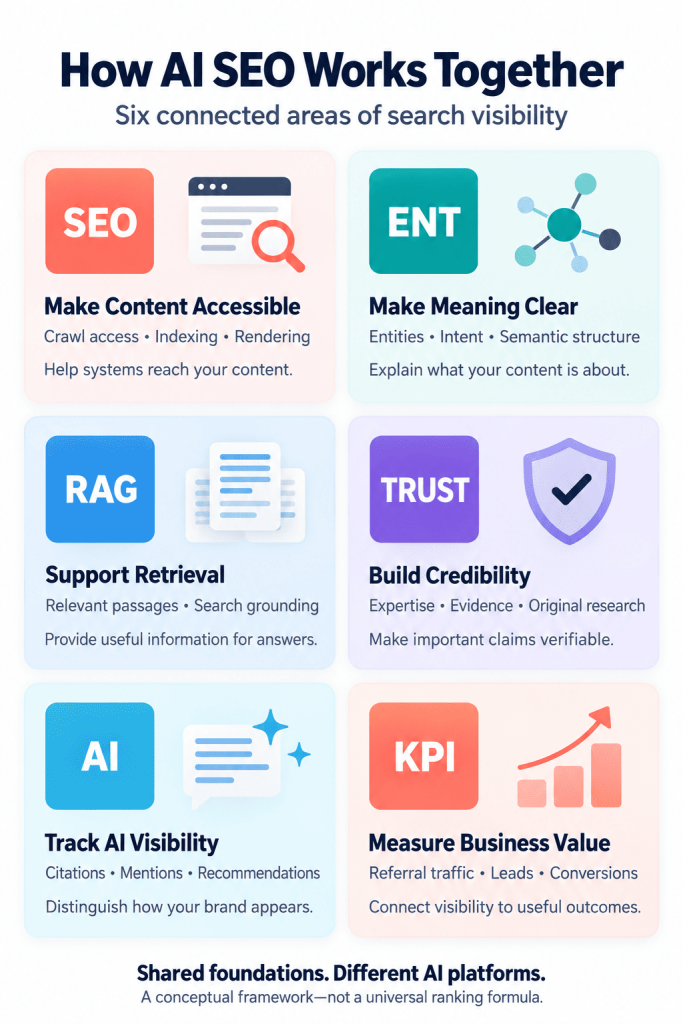
The individual elements in the periodic table are most useful when viewed as part of one search process.
Each layer plays a different role, from understanding the user’s request to deciding what information is available, generating a response, and measuring the outcome.
From Query to Search Outcome
A simplified AI-search journey looks like this:
User Query
→ Query Understanding
→ Query Expansion / Fan-Out
→ Information Retrieval
→ Relevant Passages and Sources
→ Context Assembly
→ Generated Response
→ Citation or Brand Appearance
→ Search and Business Measurement
The sequence is not identical across every platform, but it provides a useful model for understanding how the elements in the table connect.
1. The User Starts With an Information Need
Every search begins with a user trying to accomplish something: learn, compare, decide, verify, troubleshoot, or complete a task.
The system first has to interpret that need. This is why a natural-language query can be more complex than the literal words typed into the search box.
2. The Query May Be Expanded or Reformulated
A system can reformulate or expand the original request to find better supporting information.
This is the stage where a broad question can become several narrower information needs.
3. Retrieval Finds Relevant Sources
The retrieval layer searches available indexes, databases, or knowledge sources for material that matches those information needs.
At this stage, the main question is not yet what the model will say.
It is:
What information is available for the system to work with?
4. Relevant Passages Are Brought Into Context
A retrieval system may select only the most useful sections of a document rather than treating an entire page as equally relevant.
That makes structure important at the document level. A well-focused section can provide a clearer unit of information than a long page where several unrelated ideas are mixed together.
The selected material becomes part of the context supplied to the generative system.
5. The Model Produces the Response
The generative model uses the user’s request together with the available context to form the final response.
This is why modern AI search can behave more like a multi-step research process than a conventional keyword lookup.
6. Sources and Brands May Appear in Different Ways
The final response may:
- Cite a source;
- Name a brand;
- Recommend a product or company;
- Summarize information without naming the source;
- Present several supporting references.
Measure these outcomes separately because they represent different kinds of search presence.
7. Measurement Closes the Loop
The final layer is evaluation.
Teams can compare:
- Which queries produce brand appearances;
- Which sources are cited;
- Where competitors appear instead;
- Whether visibility changes over time;
- Whether search exposure contributes to qualified traffic or conversions.
Where Traditional AI SEO Fits Into the System
Traditional AI SEO supports the parts of the process that happen before an AI-generated response is created.
A site still needs discoverable pages, clear information architecture, accessible content, relevant subject coverage, and credible external references. AI search adds additional layers on top of those foundations, but it does not make them unnecessary.
The relationship can be summarized as:
- AI SEO makes information discoverable and competitive.
- Retrieval determines what information enters the AI workflow.
- Generation turns that information into an answer.
- Measurement shows whether the brand gained meaningful search presence.
This system view helps prevent the AI AI SEO Periodic Table from becoming a list of isolated tactics. The elements work together as parts of one search journey, but the importance of each part can change depending on the AI platform being used.
Does AI AI SEO Work the Same Across Every AI Search Engine?
No. AI AI SEO does not work exactly the same across every AI platform. ChatGPT, Gemini, Google AI search, Perplexity, Claude, and Grok should be treated as separate discovery surfaces because their products, available information, retrieval behavior, and generated responses can differ.
| AI Search Surface | What Makes It Distinct | What AI SEO Teams Should Monitor |
| ChatGPT | Conversational discovery where users can ask category, comparison, recommendation, and follow-up questions within the same interaction. | Brand appearances across important prompts, recurring recommendations, cited domains, competitor presence, and consistency across repeated tests. |
| Gemini | A standalone AI experience within Google’s wider ecosystem. It should not automatically be treated as identical to a conventional Google Search result. | Entity appearances, recommendation context, source patterns, and visibility across a controlled set of relevant prompts. |
| Google AI Overviews & AI Mode | AI-generated experiences are integrated directly into Google Search. | Supporting-source inclusion, brand appearances, query categories that trigger generated answers, and differences between AI-search visibility and ordinary organic results. |
| Perplexity | An answer-oriented search experience where source references are a prominent part of the interface. | Frequently cited domains, citation recurrence, competitor citations, missing-source opportunities, and changes across repeated prompt checks. |
| Claude | Primarily a conversational AI environment rather than a conventional search-results interface. | Whether the brand or source appears for research, evaluation, comparison, and recommendation prompts relevant to the business. |
| Grok | A distinct AI environment with its own product context and generated-answer behavior. | Brand references, citations where available, competitor recommendations, recurring source patterns, and category-level presence. |
Why Platform-by-Platform Measurement Matters
The key principle is not to assume visibility transfers automatically from one AI system to another.
Instead of reporting one broad score such as:
AI Visibility: 42%
A more useful view is:
ChatGPT visibility | Google AI visibility | Gemini visibility | Perplexity visibility | Claude visibility | Grok visibility
This approach shows where a brand performs consistently, where competitors appear more often, and which search surfaces need closer investigation.
The same caution applies to optimization advice. There is currently no single universal AI-search ranking algorithm that applies equally to all of these systems.
So the practical rule for the AI AI SEO Periodic Table is:
Measure each surface separately, compare trends over time, and avoid treating one platform’s behavior as a rule for every AI search engine.
What is Likely to Change in AI AI SEO in 2027?
AI AI SEO is likely to become less about optimizing individual pages and more about managing how a brand’s information is created, structured, verified, distributed, and measured across multiple search experiences.
The most significant expected changes are strategic. They affect how teams produce information, how that information is maintained, and how search performance is connected to business outcomes.
| Expected 2027 Shift | What Is Changing | What AI SEO Teams Should Do |
| Search Becomes More Multimodal | Search increasingly includes text, images, voice, and visual inputs instead of relying only on typed queries. | Choose the format that best explains each idea. Use written content, original images, diagrams, video, demonstrations, or structured resources where they genuinely improve understanding. |
| Optimization Moves From Pages to Information Assets | A single page is no longer the only useful unit of search optimization. Original datasets, expert commentary, product documentation, research, diagrams, calculators, and other reusable resources can support multiple discovery experiences. | Build durable information assets that can support several queries, formats, and search journeys instead of creating pages only to target isolated keywords. |
| Search Strategy Requires Cross-Team Ownership | AI search increasingly touches content, AI SEO, engineering, PR, brand, analytics, and product teams at the same time. | Define ownership clearly. Content teams manage subject depth, engineering manages technical delivery, PR supports external visibility, brand maintains consistency, and analytics tracks performance. |
| First-Party Evidence Becomes More Valuable | Generic explanations are easy to reproduce. Original research, first-hand testing, internal data, expert observations, and proprietary analysis provide information that competing pages may not contain. | Invest in evidence that originates from the business and can be checked, cited, or independently validated. |
| AI Search Creates New Governance Needs | Generated experiences can surface outdated, incomplete, or inconsistent information about products, people, services, and brands. | Maintain authoritative source material, document important facts, review outdated claims, and create processes for updating information when products, policies, pricing, or capabilities change. |
| Search Measurement Moves Toward Business Impact | Visibility alone does not show whether search contributes to meaningful business results. | Connect search performance with qualified leads, conversions, revenue, branded demand, customer acquisition, and other outcomes tied to business goals. |
What This Means for AI SEO Teams
The practical change is a move from page optimization to information management.
An expert AI SEO professional should ask:
- Do we own useful information that competitors cannot easily reproduce?
- Is that information available in the right format?
- Who is responsible for keeping important facts accurate?
- Can different teams contribute to search visibility without creating conflicting signals?
- Can we connect search activity to real business outcomes?
This is where AI AI SEO becomes more operational.
Instead of treating AI SEO as a publishing function, teams increasingly need a system for creating reliable information, maintaining it, distributing it effectively, and measuring what it contributes to the business.
Build an AI AI SEO Strategy for 2027
The AI AI SEO periodic table can help identify the elements involved, but turning those elements into measurable growth requires a coordinated strategy.
RedBlink Technology helps businesses connect traditional AI SEO with AI-search visibility, content architecture, technical readiness, entity signals, and AI-driven digital growth.
The goal is not simply to appear in more search experiences, but to build an information ecosystem that supports discovery, trust, qualified traffic, and conversions.
Ready to strengthen your visibility for the next generation of search? Talk to the Search Engine Optimization experts of RedBlink Technology about building an AI AI SEO strategy designed for 2027 and beyond.