
Last Updated on September 23, 2026
If you are looking for a Jev AI alternative, the best option depends on what you actually need to replace.
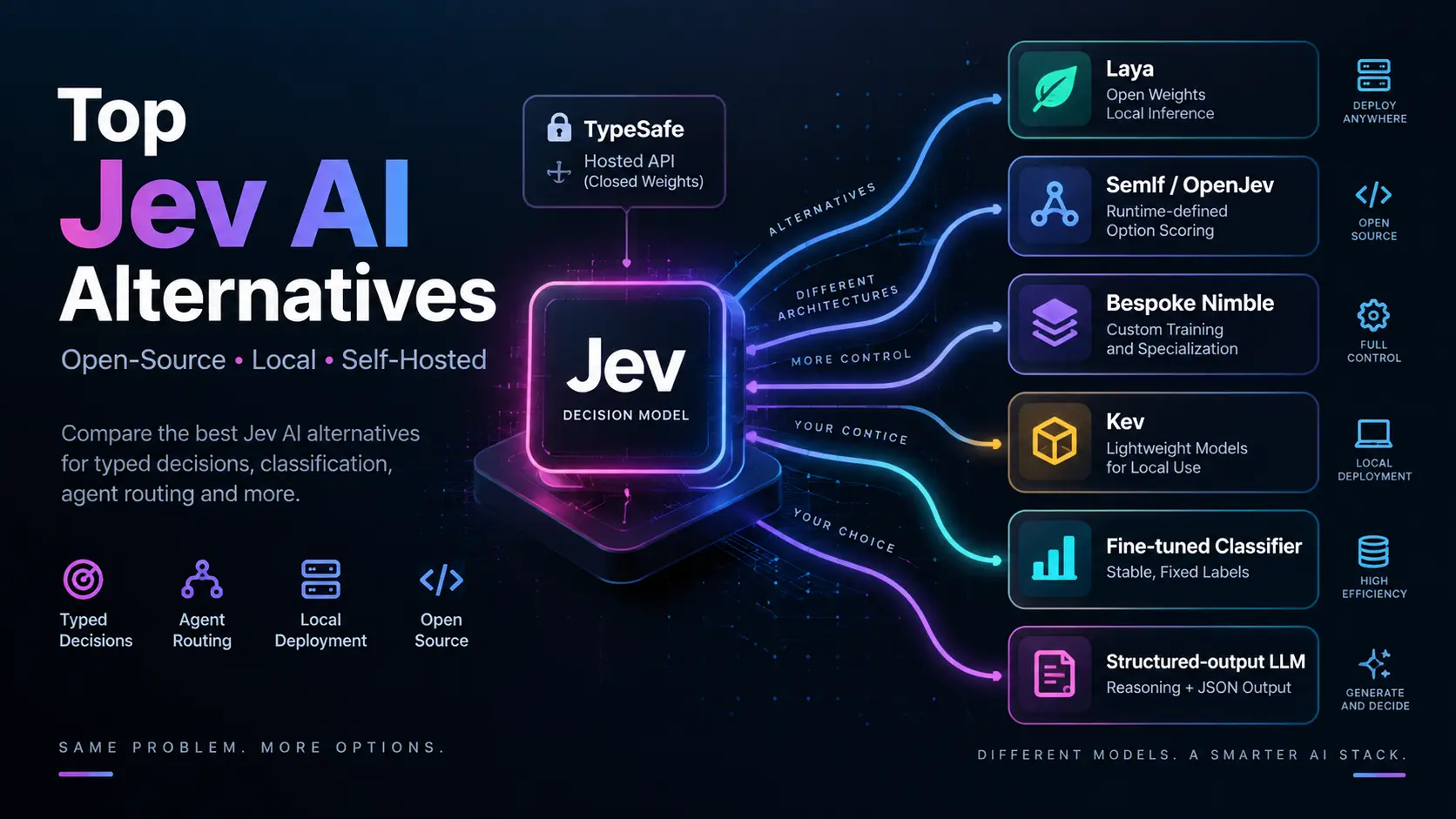
For open-source and local typed decisions, Laya is one of the strongest dedicated alternatives. For runtime-defined decision scoring over open models, SemIf/OpenJev is a closer interface-level substitute. Bespoke Nimble is more suitable if you want to control the training recipe, while a fine-tuned classifier can be better when your label set is fixed. If the task also requires reasoning or generated text, a structured-output LLM may be a better fit than any Jev-style decision model.
The most important distinction is that there is currently no verified open-weight version of TypeSafe’s Jev itself. Jev remains a hosted, closed-weight System One Model, while community alternatives reproduce different parts of its interface or decision behavior using separate architectures.
Jev AI Alternatives at a Glance
| If You Need | Strong Starting Point | Why |
|---|---|---|
| Open weights + local typed decisions | Laya | Dedicated open decision-model family |
| Jev-like runtime-defined option scoring | SemIf / OpenJev | Uses open models for typed choices |
| Custom training and specialization | Bespoke Nimble | Open training recipe |
| Small/local experimental models | Kev / NanoJev / similar projects | Useful for research and local System One experiments |
| Stable, fixed-label classification | Fine-tuned classifier | Fast and inexpensive once trained |
| Reasoning + JSON/schema output | Structured-output LLM | Better when generation is also required |
The alternatives are therefore not interchangeable.
Some are model replacements, some are interface reproductions, some are classifiers, and some are structured-output LLM approaches. The right comparison is not simply “Which one is most like Jev?” but:
Which option gives you the right balance of accuracy, calibration, latency, openness, deployment control, and operating cost?
Jev’s Verified Baseline Before You Compare Alternatives
Before evaluating alternatives, it helps to establish what Jev itself currently offers.
TypeSafe’s official launch documentation describes Jev as a System One Model that accepts unstructured program state and returns typed probabilistic decisions using Choice, Score and Noul primitives. TypeSafe says those outputs are generated in parallel and trained using Reinforcement Learning for Calibrated Decisions (RLCD).
As of September 2026, TypeSafe publishes:
- $0.042 per million input tokens
- No separately metered output-token charge
- Approximately 70–500 ms end-to-end response time
- Up to 193.6× faster and 444.6× cheaper in TypeSafe’s own workflow evaluations, which the company says represent the higher end of expected real-world gains
TypeSafe just priced output tokens at zero.
Input is $0.042 per million tokens, per the launch. Every yes or no from a language model arrives inside a sentence it had to write one token at a time, and you pay for the whole sentence. Pricing output at zero follows from a model… https://t.co/aSrqqtygGf
— Aakash Gupta (@aakashgupta) September 15, 2026
Jev was adopted faster than any other model in AI Gateway history.
In the first day, @typesafeai reached ~13% of teams, 2x the GPT-5.6 family and 6x Fable 5.1. pic.twitter.com/kVEuLM1npu
— Vercel (@vercel) September 18, 2026
Those figures make an important point:
The main reason to look for a Jev alternative is not necessarily price.
The stronger motivations visible across the current search results are:
- open weights
- local inference
- self-hosting
- offline or private deployment
- model customization
- hardware control
- avoiding dependence on a hosted API
That distinction matters because Jev itself is already unusually inexpensive compared with full generative-model inference. The real alternative question is often about control and deployment, not simply cost.
For teams comparing decision models inside larger AI agent systems, the same principle applies: a faster model is only useful if it fits the routing, confidence, privacy, and infrastructure requirements of the workflow.
The Questions This Guide Answers
The current SERPs, AI Overviews & LLMs around Jev AI alternatives repeatedly expands into the same practical questions:
Is Jev open source?
No. TypeSafe has not released Jev’s weights, parameter count, full architecture, or RLCD training recipe. Jev is currently accessed as a hosted service.
Can you run Jev locally?
Not the TypeSafe Jev model itself. Running a Jev-style decision model locally currently means using an independent alternative such as Laya, SemIf/OpenJev, Kev, NanoJev, or another open implementation.
What is the closest open-source alternative to Jev?
There is no universally accepted drop-in replacement. Laya is closer to a dedicated open decision model, while SemIf/OpenJev is closer to reproducing Jev-like runtime-defined option scoring over open models. Other projects optimize for different layers of the stack.
Is Laya better than Jev?
Not universally. Published results vary by dataset, checkpoint, fine-tuning, calibration, option count, and hardware. Some benchmarks favor Laya on specific tasks while others favor Jev, so both should be tested on the same production-like workload before drawing conclusions.
Are open-source Jev alternatives actually calibrated?
Not automatically. A model can return probabilities without those probabilities being well calibrated. This is one of the biggest differences between simply reproducing Jev’s output format and reproducing its claimed decision behavior. Independent alternative directories repeatedly flag calibration as a major unresolved comparison point.
Should you use a Jev alternative, a classifier, or a structured-output LLM?
- Use a Jev-style decision model when you need fast bounded judgments with runtime-defined options.
- Use a fine-tuned classifier when the label set is stable and you already have labeled data.
- Use a structured-output LLM when the same call also needs reasoning, explanation, or generated text.
That distinction is central to the rest of this guide and prevents comparing systems that solve fundamentally different problems.
What Is Jev AI—and Why Are Developers Looking for Alternatives?
Jev is TypeSafe AI’s first public System One Model, designed to make fast, structured decisions inside software rather than generate open-ended text. TypeSafe describes the model as taking unstructured state and returning typed probabilistic decisions that software can consume directly. Its API supports Choice, Score, and Noul question types for tasks such as classification, routing, scoring, verification, and workflow branching.
That puts Jev in a different category from conventional generative AI models, which are primarily optimized to create text, code, explanations, and other open-ended outputs.
A useful shorthand is:
Jev → makes a bounded decision
Generative LLM → creates an open-ended response
That distinction is also what creates demand for Jev AI alternatives.
Developers looking for an alternative are not necessarily trying to replace Jev because of poor performance or high API pricing. TypeSafe itself publishes relatively low metered pricing and positions Jev around low-latency decision workloads.
Instead, the strongest alternative intent is around deployment and control.
Jev is currently exposed as a hosted TypeSafe API, while several newer projects are attempting to reproduce or reinterpret the same decision-model pattern through open weights, local inference, self-hosting, or alternative decision architectures. Apidog’s review of the emerging ecosystem, for example, identifies OpenJev, mini-jev, jevlike, parallel constrained decoding, and a vLLM-based approach as different attempts to approximate Jev-like typed decisions locally.
The alternatives do not all work the same way.
Some read option probabilities directly from open language models. Others use purpose-built scorers or parallel constrained decoding. OpenJev, for example, uses a Qwen-based model to score runtime-defined options directly in a single forward pass rather than generating the answer token by token.
Laya takes a different route. Its published model family uses a bidirectional encoder plus decision heads and exposes typed outputs for choice, score, and noul-style questions. Its official model documentation lists open checkpoints, local deployment, multiple language variants, and one-pass evaluation of typed questions.
That means a model can look Jev-like at the interface level without being equivalent to Jev underneath.
This is one of the most important distinctions when comparing TypeSafe Jev with open-source alternatives:
Matching Jev’s output shape does not automatically mean matching its training method, probability calibration, zero-shot behavior, or production reliability.
Apidog makes this distinction explicitly: several community reproductions can return typed choices and probability-like scores, but they do not reproduce TypeSafe’s undisclosed model architecture or RLCD training process.
So the useful comparison is not simply:
Jev vs another AI model
It is:
Which decision approach gives you the right balance of accuracy, calibration, latency, deployment control, openness, hardware requirements, and operating cost?
How Jev AI Works—and What an Alternative Needs to Match
Before comparing Jev AI alternatives, it helps to define what an alternative is actually trying to replace.
Jev is not simply an API that returns JSON. TypeSafe designed it around a specific decision interface:
State → typed question → bounded answer space → probabilities → software action
The application supplies the information Jev should evaluate, defines the decision it needs, and constrains the possible outputs in advance. Jev then evaluates those possible answers without generating a free-form response.
That baseline matters because many projects described as “Jev alternatives” reproduce only part of this behavior.
A local model may return one of several predefined choices. A structured-output LLM may guarantee valid JSON. A classifier may return softmax probabilities. But those systems do not automatically have the same training objective, calibration properties, dynamic question interface, or zero-shot behavior as TypeSafe’s Jev.
TypeSafe’s System One Model launch documentation describes Jev as taking unstructured program state in and returning typed probabilistic decisions out, with outputs produced in parallel rather than through conventional token-by-token text generation.
State + Typed Questions: Jev’s Decision Interface
Jev evaluates decisions against a supplied state.
The state is the information relevant to the current decision. Depending on the application, it might contain:
- A support ticket
- An email
- Account information
- Product or transaction data
- Policy text
- Tool output
- Structured application context
The developer then defines one or more questions about that state.
For example, a customer-support application might provide this state:
“My card was charged twice for the same order, and I need this fixed today.”
It could then ask:
- Which department should handle the request?
- How urgent is the case?
- Is the customer requesting a refund?
This separation is important.
The state provides evidence, while the question defines the judgment.
That also makes the decision layer different from a conventional classifier whose label set may be fixed during training. Jev’s questions and answer criteria can be supplied as part of the request, which is one of the capabilities an alternative should be evaluated against.
For workflows where the relevant evidence first has to be located from a larger knowledge source, that decision layer can also sit after retrieval-augmented generation and retrieval systems: retrieval finds the relevant context, while the decision component evaluates what that context means for the next action.
Choice, Score and Noul: The Three Jev Primitives
TypeSafe exposes three main decision primitives:
| Jev Primitive | What It Returns | Example | Common Use |
|---|---|---|---|
| Choice | A selection from predefined options plus probabilities | Billing / Technical / Sales | Classification, routing, tool selection |
| Score | A position on an ordered scale plus a probability distribution | Low / Medium / High urgency | Severity, quality, prioritization |
| Noul | A probability that a statement is true | “The customer wants a refund” | Verification, gating, detection |
These primitives provide a useful benchmark for evaluating alternative implementations.
For instance, some open projects support only Choice-like classification, while others attempt to reproduce all three primitives.
Apidog’s comparison of open Jev-style projects notes that implementations vary substantially: some read option logits from frozen language models, some train dedicated scorers, and others use parallel constrained decoding. It also cautions that reproducing the shape of Jev’s API does not mean reproducing Jev’s underlying RLCD training or calibrated probabilities. See Apidog’s breakdown of open-source Jev alternatives.
That distinction becomes especially important for confidence.
A softmax score from a language model can tell you which option received the strongest model preference. It does not automatically mean that a reported probability of 0.90 corresponds to a decision that is correct roughly 90% of the time.
Calibration is a separate property.
Why Jev-Like Outputs Are Not Necessarily Jev-Equivalent
This is the key comparison principle for the rest of the article:
Interface compatibility is not model equivalence.
Several emerging alternatives can produce outputs that look like Jev:
State
   ↓
Question
   ↓
Choice / Score / Boolean
   ↓
Probability
But they may arrive at those outputs through very different architectures.
For example:
- OpenJev-style implementations can score candidate answers from an open language-model backbone rather than generate full prose.
- Laya uses an open decision-model architecture designed around typed decisions and local deployment.
- Traditional encoder classifiers can be extremely fast when the label space is fixed and labeled training data is available.
- Structured-output LLMs can enforce a schema while still using autoregressive generation underneath.
Laya’s published materials, for example, expose typed-decision checkpoints and report separate performance for Choice, Score, and Noul tasks; its own benchmark documentation also distinguishes between fine-tuned performance and weaker zero-shot base-model results. Review the Laya typed-decisions model card.
Likewise, open Jev reproductions explicitly warn that matching TypeSafe’s request/response format does not prove they match the production Jev model or its private training process.
So when comparing Jev with an alternative, evaluate at least five separate questions:
- Does it support runtime-defined decisions, or only fixed labels?
- Does it support Choice, Score, and boolean-style judgments?
- Are its probabilities actually calibrated or simply normalized logits?
- Can it evaluate several decisions efficiently in one pass?
- Can it run in the deployment environment you require—hosted, local, or self-hosted?
Those criteria provide a much stronger basis for comparing Jev alternatives than asking whether another model can simply return the same JSON structure.
What Are the Main Alternatives to Jev AI?
There is no single category of Jev AI alternative.
The right substitute depends on which part of Jev you actually need:
- Typed decisions
- Probability-aware classification
- Fast local inference
- Structured JSON output
- Open weights
- Text generation
- Fixed-label prediction
- Agent routing or workflow control
That is why comparing Jev only against general-purpose LLMs can be misleading.
A more useful way to think about the market is to group alternatives by decision architecture.
| Alternative Type | Best Fit | Main Trade-Off vs Jev |
|---|---|---|
| Open decision models | Local/self-hosted typed decisions | More control, but calibration and maturity vary |
| Structured-output LLMs | JSON/schema-constrained responses | More flexible, but still generative underneath |
| Fine-tuned classifiers | Stable label sets at high volume | Very fast, but require labeled data and retraining |
| General-purpose LLMs | Reasoning + writing in one call | Flexible, but usually slower and more expensive for simple judgments |
This taxonomy matters because the current Jev ecosystem includes projects that solve similar workflow problems through very different mechanisms.
Structured-Output LLMs vs Jev AI
A structured-output LLM is one of the most obvious substitutes for Jev when the main requirement is:
“Return a valid structured response that my software can parse.”
Modern LLM APIs can constrain responses to a JSON schema or another predefined structure.
OpenAI’s official API documentation, for example, states that Structured Outputs can enforce a supplied JSON schema so the generated response matches the declared structure.
That solves an important production problem: malformed output.
But it is not the same problem Jev is designed to solve.
A structured-output LLM still uses a generative model underneath. It produces a response according to the schema, but the schema itself does not automatically provide:
- A probability distribution over every option
- Calibrated confidence
- Parallel decision primitives
- The same low-latency decision architecture
- A decision-specific training objective
TypeSafe describes Jev differently: its possible outputs are defined in advance, all answers are typed, and Choice/Score-style outputs are accompanied by probabilities and confidence rather than only a selected value.
So the practical distinction is:
Structured-output LLM → generative model constrained to a schema
Jev-style model → decision model optimized around bounded probabilistic outputs
A structured-output LLM can be the better alternative when you already need reasoning, explanation, or text generation in the same request.
If you are already comparing general models for those workloads, RedBlink’s LLM comparison guide provides a broader view of the trade-offs among current general-purpose models.
Fine-Tuned Classifiers vs Jev AI
A traditional classifier may be a better Jev alternative when the decision problem is stable.
Suppose an application always needs to classify support tickets into the same five departments:
- Billing
- Technical support
- Shipping
- Sales
- Account management
If those labels rarely change and you have enough labeled examples, a fine-tuned encoder classifier can be extremely fast and inexpensive to run.
This is a different design philosophy from Jev.
A traditional classifier usually learns a fixed label space during training.
Jev, by contrast, is designed so the application can define questions and answer criteria at request time.
That distinction creates a useful rule:
Fixed decision taxonomy + labeled data → classifier may be ideal
Changing decision criteria + little task-specific training data → Jev-style model may fit better
The OpenTweet alternatives analysis makes the same architectural distinction, noting that fine-tuned BERT-style classifiers can be excellent for stable, high-volume label sets but require training data and retraining when the classification space changes.
This category is especially relevant because some so-called “Jev alternatives” are functionally closer to specialized classifiers than to a true drop-in Jev replacement.
Open Decision Models vs Jev AI
The fastest-growing alternative category is the set of open or locally runnable decision models inspired by Jev’s interface.
Projects currently discussed in this category include:
- Laya
- OpenJev / SemIf
- mini-jev
- jevlike
- Bespoke Nimble
- Kev-0.5B
- DiffusionGemma-based approaches
Latent Space’s roundup of the early Jev ecosystem shows just how quickly different architectures appeared after launch: encoder-based decision models, Qwen-based classifiers, LoRA-tuned systems, option-attention models, and diffusion-based approaches all emerged within days.
These systems are attractive for different reasons:
- Open weights
- Local inference
- Offline use
- Auditability
- Custom fine-tuning
- Hardware control
- No dependency on a hosted TypeSafe endpoint
But they should not be treated as equivalent simply because they return typed answers.
Apidog’s technical review shows that open reproductions differ substantially in their capabilities. Some support only Choice-like behavior, some expose boolean decisions, some return raw or normalized logits, and none of the surveyed projects independently reproduce TypeSafe’s undisclosed RLCD training process.
That makes probability calibration one of the most important comparison criteria.
A model that returns 0.91 is only operationally useful if that number has a meaningful relationship with real-world correctness.
Open weights alone do not guarantee that.
When a General-Purpose LLM Is the Better Alternative
Sometimes the best alternative to Jev is simply an LLM.
Use a general-purpose model when the task requires:
- Writing a reply
- Summarizing content
- Producing code
- Explaining a decision
- Multi-step reasoning
- Handling multimodal inputs
- Combining judgment and generation in one call
Jev intentionally gives up free-form string generation.
That trade-off is part of why it can specialize in fast decision workloads.
TypeSafe’s own launch material explicitly contrasts Jev’s typed probabilistic outputs with the string generation used by conventional LLMs.
The important takeaway is therefore:
The best Jev alternative depends on the job, not the model name.
If the application needs:
- Fast typed decisions: compare Jev with open decision models.
- Fixed-label classification: compare Jev with fine-tuned classifiers.
- Schema-safe generation: compare Jev with structured-output LLMs.
- Reasoning or writing: use a general-purpose LLM.
That framework makes the named alternatives in the next section much easier to evaluate on their actual merits.
Top Jev AI Alternatives: Open-Source, Local and Self-Hosted Options
The strongest Jev AI alternatives are not simply cheaper LLMs.
Most current projects are trying to reproduce one or more parts of Jev’s decision-model pattern:
- Accept unstructured state
- Ask predefined questions
- Return typed answers instead of prose
- Produce probabilities or confidence signals
- Avoid long autoregressive generation
- Run locally or on self-managed hardware
That distinction matters for teams building AI agent architectures, because classification, routing, verification, and escalation are often better treated as narrow decision tasks than as full text-generation problems.
The alternatives differ mainly in how they implement that decision layer.
Some are dedicated decision models. Others reuse open language-model backbones and read option probabilities directly. A third group changes the decoding or inference mechanism rather than training an entirely new model.
That makes architecture, calibration, deployment model, hardware requirements, and task fit more useful comparison criteria than simply asking which project is “most like Jev.”
| Alternative | Open / Local | Core Approach | Jev-Like Output | Strongest Fit |
|---|---|---|---|---|
| Laya | Yes | Dedicated encoder-based decision model | Choice, Score, Noul-style outputs | Local typed decisions, routing, classification |
| SemIf / OpenJev | Yes | Reads option probabilities from open LLMs | Primarily Choice-style decisions | Runtime-defined local choices |
| mini-jev | Yes | Frozen Qwen option-logit reading | Choice + boolean-style decisions | Lightweight experimentation |
| Bespoke Nimble | Yes | Fine-tuned open model for typed decisions | Choice and true/false questions | Custom decision workflows |
| Kev | Yes | LoRA + decision head over Qwen | Jev-style decision contract | Small local research models |
| jevlike | Yes | Purpose-built option scorer | Choice-style probabilities | Fixed trained decision workloads |
| Diffusion / vLLM approaches | Experimental | Parallel or diffusion decoding | Choice / scale-like outputs | Non-autoregressive inference research |
Laya: Open-Source Jev Alternative for Local Typed Decisions
Laya is one of the clearest open-weight alternatives to Jev because it is designed specifically around typed decision-making rather than free-form text generation.
Its published model family supports the same broad decision shapes associated with Jev:
- Choice for selecting among predefined options
- Score for ordered evaluation
- Noul for estimating whether a proposition is true
Laya is particularly relevant for teams prioritizing local inference, privacy, offline deployment, inspectable weights, or control over the inference environment.
That makes it conceptually closer to Jev than a normal chat model forced into a JSON schema.
However, the benchmark picture is more nuanced than the headline numbers suggest.
The Flowtivity analysis you shared reports strong fine-tuned results for Laya but also highlights materially weaker zero-shot performance, degradation with large option sets, short context limits on some checkpoints, and calibration work that may be required before probabilities can safely control production thresholds.
That makes Laya best understood as:
an open, locally deployable decision-model alternative with more infrastructure responsibility
rather than a universal drop-in replacement for Jev.
The operational trade-off is important. Self-hosting may eliminate a metered API bill, but it introduces GPU, deployment, monitoring, and maintenance costs. Teams comparing these economics should evaluate the whole inference stack, not just token pricing—a principle that also applies to broader AI inference cost optimization.
SemIf / OpenJev: Jev-Like Decisions From Open Models
OpenJev, now discussed in parts of the ecosystem under the SemIf name, takes a different route.
Instead of attempting to reproduce TypeSafe’s undisclosed training process, it recreates the decision interface pattern using open language models.
The project scores candidate answers directly rather than asking the model to generate a complete prose or JSON response. Apidog’s review describes OpenJev as reading option logits from a frozen Qwen-based model and explicitly notes that this reproduces the interface pattern, not Jev’s private architecture or RLCD training.
This approach is useful for developers who want:
- Runtime-defined option sets
- Local GPU inference
- Open model weights
- No full autoregressive answer generation
- A Jev-like probability interface
The critical limitation is calibration.
A softmax distribution over option logits tells you how strongly the model prefers one option relative to others.
It does not automatically prove that a reported probability such as 0.90 corresponds to approximately 90% real-world correctness.
That makes the distinction:
probability output ≠ calibrated probability
one of the most important criteria when evaluating OpenJev-style alternatives.
Developers considering this class should inspect the OpenJev project and implementation directly rather than relying only on benchmark screenshots or second-hand comparisons.
mini-jev: Lightweight Local Jev-Style Classification
mini-jev is better treated as an experimental reproduction of the Jev interaction pattern than as a production replacement.
According to the technical comparison you supplied, it uses a frozen Qwen model and compares conventional structured generation against directly reading option-letter logits. It focuses mainly on Choice-like classification and boolean decisions, rather than reproducing Jev’s full primitive set.
The project is useful for testing a more fundamental question:
Do we need to generate an answer at all if the application only needs a decision?
That makes mini-jev relevant for prototyping:
- Intent classification
- Routing
- Binary gating
- Lightweight confidence experiments
- Local decision endpoints
Its own reported behavior also reinforces an important point: option logits can be useful ranking signals without necessarily being calibrated probabilities.
For production systems, that distinction matters because routing errors compound quickly when one decision feeds another. This is one of the same architectural issues RedBlink discusses in the context of production AI failure modes.
Bespoke Nimble: Open Typed Decisions With a Trainable Recipe
Bespoke Nimble approaches the Jev-alternative problem through a more explicit training recipe.
The project was highlighted in the Latent Space roundup as a LoRA-tuned Qwen-based system using synthetic contrastive data curation for typed decisions.
That makes Nimble attractive to teams that care about:
- Training transparency
- Local deployment
- Custom data
- Typed decision serving
- Fine-tuning behavior for a particular workload
Rather than providing only a hosted decision API, it gives developers more control over how the decision model is created.
The trade-off is that more control means more engineering responsibility.
A hosted model such as Jev shifts infrastructure, serving, model updates, and much of the calibration burden to the vendor.
An open recipe such as Nimble shifts more of that burden back to the team running it.
Developers interested in that approach should review the Bespoke Nimble repository and its current evaluation methodology before treating published results as directly comparable with Jev.
Kev: Small Jev-Compatible Decision Models for Local Research
Kev explores how small a Jev-style decision model can become while still exposing a useful typed interface.
The Latent Space ecosystem roundup describes Kev-0.5B as a LoRA adapter and readout head built on Qwen2.5-0.5B, aimed at local decision-model experimentation.
That makes Kev relevant for developers exploring:
- Very small local models
- Jev-compatible API patterns
- Decision heads over open backbones
- Probability readouts
- On-device inference
- System One-style research
Its small size is part of the appeal, but also the reason it should be treated cautiously.
A model that demonstrates the architecture successfully is not automatically a production-quality replacement for a larger, purpose-trained system.
The broader lesson is that model size, openness, calibration, accuracy, and deployment maturity are separate attributes.
Teams interested in Kev should evaluate the Kev project documentation against their own decision workload rather than assuming that API compatibility implies behavioral equivalence.
jevlike and Diffusion-Based Approaches: Experimental Jev Alternatives
Several other projects attack the same problem from different directions.
jevlike uses a dedicated option-scoring architecture rather than simply wrapping a chat model. According to the comparison material you shared, it behaves more like a classifier trained for a specific workload than a zero-shot Jev replacement.
Developers can inspect the jevlike source repository to understand the option-attention design and training requirements.
Another branch of experimentation uses diffusion or parallel constrained decoding.
A vLLM pull request discussed in the competitor sources explores a Jev-like mode for DiffusionGemma, with decisions read from constrained answer positions rather than generated as long autoregressive sequences.
The Latent Space roundup also identifies DiffusionGemma-based approaches as one of the main architectural directions appearing around Jev.
These projects are particularly interesting because they ask a broader question:
Can structured decisions be generated in parallel without building an entirely separate decision model?
That makes them relevant research alternatives, but their maturity varies. An unmerged inference-engine pull request should not be evaluated the same way as a maintained production API or an actively released model family.
Which Jev AI Alternative Should You Choose?
The right option depends on what you are actually trying to replace.
| Requirement | Stronger Starting Point |
|---|---|
| Open weights + local typed decisions | Laya |
| Runtime-defined option scoring | SemIf / OpenJev |
| Lightweight Jev-style experiments | mini-jev |
| Custom fine-tuning and training control | Bespoke Nimble |
| Very small local decision models | Kev |
| Fixed, trained option scoring | jevlike |
| Parallel / non-autoregressive experimentation | Diffusion-based approaches |
| Reasoning + writing + schema-safe response | Structured-output LLM |
The important point is that “open-source Jev alternative” is not one technical category.
Some projects are genuine decision-model alternatives.
Some reproduce Jev’s interface using existing language models.
Some are specialized classifiers.
Others are experimental inference techniques.
So the next question should not be:
Which one is the best Jev clone?
It should be:
Which alternative performs best for my workload across accuracy, calibration, latency, deployment control, hardware, cost, and production maturity?
That is the comparison that matters for real deployment decisions.
Jev vs Laya vs SemIf vs Nimble: Speed, Cost, Accuracy and Deployment Compared
The biggest mistake when comparing Jev AI alternatives is treating one benchmark number as a universal measure of model quality.
These systems differ in architecture, hardware, training method, deployment model, and benchmark setup. Some results come from vendor testing, some from project maintainers, and a smaller number now come from independent same-input evaluations.
So the useful comparison is multidimensional:
| Dimension | Jev | Laya | SemIf / OpenJev | Bespoke Nimble |
|---|---|---|---|---|
| Deployment | Hosted API | Local / self-hosted | Local / self-hosted | Local / self-hosted |
| Weights | Closed | Open | Open-model backbone | Open recipe/model |
| Decision style | Native typed decisions | Dedicated decision model | Direct option scoring | Fine-tuned typed decisions |
| Runtime-defined options | Yes | Yes | Yes | Yes |
| Probability output | Yes | Yes | Yes | Yes |
| Calibration claim | RLCD-trained | Varies by checkpoint / calibration setup | Depends on workload calibration | Project-specific |
| Text generation | No | No | No | No |
| Operational burden | Low | Higher | Higher | Higher |
| Best fit | Managed decision API | Local/private deployment | Open-model experimentation | Custom training workflows |
This table is intentionally architectural rather than numerical because raw latency and accuracy figures are not directly comparable unless the inputs, hardware, model version, and evaluation protocol match.
Which Jev Alternative Is Fastest?
TypeSafe currently publishes an end-to-end response-time range of roughly 70–500 ms for Jev and prices input at $0.042 per million tokens, with output not metered separately. Those are first-party figures from TypeSafe rather than an independent benchmark.
Open alternatives can be faster under specific local setups, but the hardware matters enormously.
Laya’s own benchmark materials report very low latency on GPU-backed tests, while third-party testing has also shown that CPU-only deployment can be dramatically slower. The Flowtivity analysis you shared, for example, measured interactive performance that was impractical on a small CPU-only VPS even though GPU benchmarks were much stronger.
That means the useful question is not:
Which model has the smallest published millisecond number?
It is:
Which model meets my latency target on the hardware and deployment environment I will actually use?
This is the same systems-level distinction that matters when planning machine learning deployment infrastructure: benchmark latency is only one component of production latency.
Is Laya More Accurate Than Jev?
There is no defensible universal answer.
Laya’s own published benchmark page reports stronger results than Jev on some tasks, but also explicitly notes that the Jev figures in those tables were taken from third-party published numbers rather than measured in the same run.
More useful evidence now comes from same-input independent testing.
The sysone-bench project compared Laya and Jev on byte-identical inputs across several suites. In that evaluation, Jev scored higher on curated triage, guardrails, moderation, and a Banking77 subset; Laya scored higher on AG News and MNLI; Emotion was effectively tied.
That result is more informative than a single aggregate winner because it shows the actual pattern:
model quality is workload-dependent.
A system that performs well on topic classification may not be the strongest choice for moderation or high-cardinality intent routing.
A second reproducible benchmark project, jevbench, is also evaluating Jev alongside Laya, fine-tuned BERT, zero-shot NLI, and structured-output LLMs using shared datasets and reporting accuracy, calibration, latency, throughput, and cost together.
For teams evaluating a production decision layer, that kind of same-input comparison is more useful than comparing unrelated vendor tables.
Calibration Matters More Than Raw Confidence
This is one of the most important distinctions in the Jev alternative market.
A system can return a probability without that probability being well calibrated.
Suppose two models both return:
Billing: 0.90
If one model is correct about 90% of the time when it reports 0.90 and another is correct only 65% of the time, those outputs have very different operational value.
TypeSafe says Jev is specifically trained with Reinforcement Learning for Calibrated Decisions (RLCD) and positions calibrated probabilities as a core model property.
Open alternatives approach this differently.
Laya’s benchmark materials distinguish raw calibration from results after temperature fitting, while its published numbers vary substantially between the base model and specialized checkpoint.
SemIf has also added per-workload temperature calibration and calibrated prediction outputs to its current implementation, illustrating that calibration can be layered onto open-model scoring rather than assumed from raw logits.
This distinction should influence architecture directly:
probability → calibration → threshold → automatic action or escalation
If a workflow is going to act autonomously above a confidence threshold, calibration matters more than whether the API merely exposes a number between 0 and 1.
For broader production evaluation, RedBlink’s guide to AI due diligence is relevant because model claims should be tested against the actual workload, not accepted from headline benchmark results alone.
Which Jev Alternative Is Cheapest?
Jev itself is already inexpensive on a token basis.
At TypeSafe’s published rate, the input price is $0.042 per million tokens, with no separately metered output tokens.
That means local alternatives should not automatically be described as “cheaper.”
A self-hosted model may have $0 API token cost, but it still incurs:
- GPU or CPU infrastructure
- memory requirements
- engineering setup
- monitoring
- model upgrades
- calibration and evaluation work
- idle capacity or cloud-instance cost
So the cost comparison is really:
hosted metered inference vs owned infrastructure
not:
paid vs free
This is particularly important for Laya. Its open weights make local deployment possible, but the Flowtivity testing you provided shows why hardware choice can determine whether that deployment is practical.
At low or moderate decision volumes, Jev’s managed API pricing may be operationally simpler than running dedicated infrastructure. At larger volumes, privacy-sensitive workloads, or environments where GPU capacity already exists, self-hosting can become more attractive.
Hosted API vs Local Jev Alternatives
For many teams, deployment control will matter more than benchmark differences.
| Requirement | Hosted Jev | Local Alternative |
|---|---|---|
| Minimal infrastructure | Strong fit | More setup required |
| Data stays on your hardware | No | Yes |
| Inspectable weights | No | Usually yes |
| Offline / air-gapped use | No | Possible |
| Automatic vendor updates | Yes | You manage updates |
| Custom fine-tuning | Limited by service | Often possible |
| Hardware control | No | Yes |
| Operational maintenance | Lower | Higher |
This is where the alternative query becomes genuinely useful.
If an organization needs air-gapped deployment, audit access, local inference, model customization, or strict control over where data is processed, open alternatives solve a problem that a hosted API cannot solve simply by being faster.
If the priority is low operational overhead, zero model hosting, dynamic typed decisions, and immediate API access, Jev’s managed service has the simpler operating model.
SemIf’s own repository explicitly positions the project as an independent open implementation that can run on local NVIDIA hardware or Apple Silicon, while stating that it does not reproduce TypeSafe’s private model or training process.
Bespoke Nimble similarly emphasizes local execution and publishes its training recipe rather than positioning itself as an identical Jev reproduction.
Do Open Jev Alternatives Match RLCD?
Not necessarily.
This point should be explicit because it is one of the easiest areas for an alternatives article to become misleading.
TypeSafe says Jev is trained using RLCD, its proprietary approach for producing calibrated decisions.
Several open alternatives reproduce the behavioral interface—typed answers, option probabilities, one-pass decisions—without reproducing that training process.
SemIf states this directly in its repository: it reproduces the interface pattern using open models but does not claim to reproduce Jev’s undisclosed architecture or training.
Nimble likewise states that it was not distilled from Jev and instead publishes an independent recipe for training a System One-style model.
This leads to an important comparison rule:
Jev-like output ≠ Jev-equivalent model
An alternative should therefore be evaluated on what it actually demonstrates:
accuracy + calibration + latency + deployment + maintenance + workload fit
rather than how closely its API resembles TypeSafe’s.
What Should You Benchmark Before Switching From Jev?
A useful evaluation should test the exact decisions your production system makes, not a generic public benchmark.
At minimum, compare:
| Evaluation Dimension | What to Measure |
|---|---|
| Task accuracy | Correct decision on your labels/workflows |
| Calibration | Whether confidence predicts correctness |
| Latency | p50 and p95 on your real hardware/network |
| Throughput | Decisions per second under expected load |
| Option cardinality | Performance as choices increase |
| Context length | Degradation as state becomes longer |
| Stability | Sensitivity to wording or option order |
| Escalation quality | Accuracy when low-confidence cases are deferred |
| Infrastructure cost | API + hardware + engineering + operations |
| Failure behavior | What happens when input is ambiguous or adversarial |
This is where independent harnesses such as sysone-bench and jevbench become useful references, because they attempt to compare systems on shared inputs rather than combining incompatible vendor claims.
The decision should ultimately be based on your own production distribution.
A five-point benchmark advantage on a public dataset matters less than whether a model is well calibrated on the routing, moderation, fraud, support, or agent-control decisions your software will actually make.
That evaluation mindset also aligns with RedBlink’s broader approach to choosing an AI software development partner: architecture, deployment constraints, maintainability, and business fit matter alongside raw model capability.
Comparison takeaway
There is no single Jev alternative that dominates every dimension.
Jev offers the simplest managed decision-model experience and first-party calibration claims.
Laya offers open weights and local deployment with a dedicated decision architecture, but its performance varies significantly by checkpoint and workload.
SemIf/OpenJev offers a flexible open-model path to runtime-defined decisions, with calibration increasingly handled as an additional workload-specific layer.
Nimble is attractive when teams want a transparent training recipe and customization rather than a black-box hosted API.
For most production teams, the useful decision is therefore not:
“Which model wins?”
It is:
“Which architecture best satisfies my workload, calibration requirements, privacy constraints, infrastructure budget, and operating model?”
When Should You Choose Jev AI vs a Jev Alternative?
Choosing between Jev and an alternative is less about finding a universal “best” model and more about matching the deployment model, decision type, calibration needs, and operational constraints to the workload.
Jev is strongest when a team wants a managed decision API with runtime-defined questions, typed outputs, probabilities, and minimal infrastructure.
Open alternatives become more attractive when the priority shifts toward local inference, open weights, self-hosting, fine-tuning, offline use, or deeper control over the model and hardware.
A useful rule of thumb is:
Choose Jev for managed decision intelligence.
Choose an alternative when control over deployment or model behavior matters more than API simplicity.
Choose Jev When You Need a Managed Decision Layer
Jev is a strong fit when the application needs fast, bounded judgments but the team does not want to operate its own model-serving infrastructure.
That includes workloads such as:
- Support-ticket routing
- Content or policy classification
- Risk scoring
- Guardrails
- Tool or workflow selection
- Verification
- Escalation decisions
TypeSafe designed Jev around runtime-defined questions, meaning the application can supply the state, question, and accepted answer space at request time rather than training a separate classifier for each decision taxonomy. Its official launch material positions this as one of the central differences between Jev and conventional fixed-label classifiers. Review TypeSafe’s System One Model architecture.
Jev also makes sense when calibrated uncertainty is part of the workflow.
For example:
high confidence → automate
medium confidence → gather more context
low confidence → escalate
TypeSafe specifically trains Jev with Reinforcement Learning for Calibrated Decisions and presents probability-aware automation as a core capability.
That makes Jev attractive when the application needs not only a decision, but a signal it can use to decide whether to trust that decision enough to act.
Choose an Open-Source Jev Alternative When You Need Local Control
An open-source or open-weight alternative becomes more compelling when the model must run inside your own environment.
Common reasons include:
- Data residency requirements
- Air-gapped infrastructure
- Sensitive internal data
- Offline operation
- Custom fine-tuning
- Model inspection
- Hardware control
- Avoiding dependency on a hosted API
This is where models such as Laya, SemIf/OpenJev, and other local decision systems provide a fundamentally different value proposition from Jev.
The important benefit is not necessarily lower inference cost.
It is deployment control.
For example, Laya’s open model family is designed to run on self-managed hardware and exposes typed decision outputs through downloadable checkpoints. Its published materials emphasize local execution and open weights rather than dependence on an external API.
Similarly, SemIf/OpenJev provides an open implementation of a Jev-like decision interface using open model backbones, allowing developers to inspect and modify the stack themselves.
This distinction matters especially for companies designing private or regulated AI systems. RedBlink’s guide to responsible AI for businesses covers the broader governance considerations around data handling, oversight, and operational control.
Choose a Fine-Tuned Classifier When the Label Set Never Changes
Not every Jev workload needs a Jev-like model.
If the application always makes the same decision against a stable set of labels, a conventional classifier may be simpler.
Consider an email-routing system with four permanent categories:
- Sales
- Support
- Billing
- Spam
If the organization already has thousands of labeled examples and those labels rarely change, a fine-tuned encoder classifier can provide:
- Very low latency
- Local inference
- Low marginal cost
- Direct probability outputs
- Full control over training and deployment
The trade-off is flexibility.
A classifier trained on four categories cannot suddenly answer a new five-option question without retraining or redesign.
Jev’s runtime-defined decision interface is much more flexible for changing business rules and dynamic answer spaces.
So the choice becomes:
stable taxonomy + labeled data → classifier
dynamic questions + little task-specific training → Jev or a Jev-style model
This is also why some projects marketed as Jev alternatives are actually closer to specialized classifiers than direct substitutes.
Choose a Structured-Output LLM When You Need Reasoning and Generation Too
A structured-output LLM may be the better alternative when the application needs a decision and an explanation, summary, response, or piece of generated content.
For example:
Classify this customer request, explain why it belongs in that category, and draft a response.
That is not a natural Jev workload because Jev intentionally does not generate prose.
A generative model with a structured schema can return both the machine-readable decision and the human-readable content in one request.
OpenAI’s official Structured Outputs documentation describes this approach as constraining a model response to a supplied schema while retaining the capabilities of the underlying generative model. See OpenAI’s Structured Outputs documentation.
The trade-off is that the system still pays for generative inference even when only a small judgment is required.
That is why the architecture often becomes:
decision model → determine what should happen
then
LLM → generate only when generation is actually needed
For teams building this kind of multi-model workflow, RedBlink’s generative AI integration services are more relevant than choosing one model to perform every stage.
Choose Laya When Local Typed Decisions Matter More Than Zero-Shot Convenience
Among the current open alternatives, Laya is particularly relevant when the application needs:
- Open weights
- Local inference
- Typed decision primitives
- Custom training
- Multilingual deployment
- No per-token API billing
But those benefits come with additional responsibility.
The competitor analysis you supplied highlights several caveats:
- Performance depends heavily on checkpoint and workload.
- Fine-tuned results can be much stronger than zero-shot results.
- Larger option spaces can reduce quality.
- Calibration may require workload-specific adjustment.
- Hardware has a major effect on practical latency.
So Laya is better viewed as:
a customizable open decision platform
rather than:
Jev without the API fee.
That distinction should remain explicit throughout the article.
Choose SemIf / OpenJev When You Want a Jev-Like Interface Over Open Models
SemIf/OpenJev is useful when developers want runtime-defined options without relying on TypeSafe’s hosted model.
Its architecture is closer to:
open LLM backbone → score candidate options directly → return probabilities
than to a newly trained Jev-equivalent model.
That can be attractive for:
- Local experimentation
- Open-model deployment
- Swappable base models
- Custom calibration
- Jev-style API prototyping
But it also means the underlying probabilities should be validated carefully.
As Apidog’s technical comparison notes, open Jev-style systems can reproduce typed output behavior without reproducing Jev’s private RLCD process.
Use SemIf when openness and architecture flexibility matter more than having a vendor-trained decision model.
Choose Nimble When You Want the Training Recipe, Not Just the Model
Bespoke Nimble is particularly interesting for teams that want to understand and control how the decision model is trained.
Its open approach includes the model recipe and training workflow rather than exposing only a hosted endpoint.
That makes it a better fit for organizations that want to:
- Curate their own decision data
- Fine-tune for a specific domain
- Experiment with contrastive training
- Control serving infrastructure
- Adapt the model over time
The Bespoke Nimble repository is therefore most useful to teams treating the decision layer as something they want to own and customize, rather than merely consume.
Jev vs Alternatives by Use Case
A practical selection matrix makes the trade-offs clearer:
| Requirement | Jev | Laya | SemIf / OpenJev | Nimble | Fine-Tuned Classifier | Structured LLM |
|---|---|---|---|---|---|---|
| Managed API | Strong | No | No | No | Depends | Strong |
| Open weights | No | Yes | Yes | Yes | Yes | Usually no |
| Local / offline | No | Strong | Strong | Strong | Strong | Depends |
| Runtime-defined options | Strong | Strong | Strong | Strong | Weak | Strong |
| Calibration-first design | Strong | Requires validation | Requires validation | Requires validation | Can calibrate | Usually secondary |
| Fixed classification | Strong | Strong | Strong | Strong | Excellent | Good |
| Open-ended reasoning | No | No | No | No | No | Excellent |
| Text generation | No | No | No | No | No | Excellent |
| Minimal infrastructure | Strong | Weak | Weak | Weak | Medium | Strong |
| Custom fine-tuning | Limited | Strong | Possible | Strong | Strong | Model-dependent |
| Air-gapped deployment | No | Yes | Yes | Yes | Yes | Model-dependent |
The table also highlights why “best Jev alternative” is inherently conditional.
A team prioritizing local inference could prefer Laya.
A team prioritizing runtime-defined open-model scoring could prefer SemIf.
A company with a permanent taxonomy and years of labeled data might not need a Jev-style model at all.
And a product that must explain its answers may still need a full generative model.
When Should You Not Replace Jev?
Switching architecture has a cost.
Do not replace Jev purely because an open alternative publishes a lower latency number or a higher score on one benchmark.
Migration introduces:
- New infrastructure
- New calibration work
- Model serving
- Monitoring
- Version management
- Evaluation maintenance
- Security responsibilities
- Failure modes your team now owns
For a low-volume workload, those operational costs can easily exceed the model bill.
Jev’s published pricing is already low enough that cost alone may not justify migration, particularly when the workload only generates thousands or tens of thousands of decisions each month.
A stronger reason to switch is when the alternative provides a capability Jev’s current delivery model cannot:
local execution, open weights, offline inference, custom training, hardware ownership, or tighter data control.
That is the decision boundary worth emphasizing.
Bottom line
- Choose Jev when you want a managed, probability-aware decision service with minimal infrastructure.
- Choose Laya when open weights and local typed decisions are the priority.
- Choose SemIf/OpenJev when you want a flexible Jev-like interface over open models.
- Choose Nimble when you want to own and customize the training recipe.
- Choose a fine-tuned classifier when the taxonomy is fixed and you already have labeled data.
- Choose a structured-output LLM when generation or deeper reasoning must happen in the same call.
The right Jev alternative is therefore determined less by the project name and more by:
workload → deployment constraints → calibration → infrastructure → required output
Which Jev AI Alternatives Work Best for Agent Routing and Decision Workflows?
AI agents create many small decision points before a task is complete.
An agent may need to determine:
- Which tool should handle the request?
- Which specialist agent should receive the task?
- Is the retrieved information relevant?
- Did the previous action succeed?
- Should the system retry?
- Does the case need human review?
- Is the confidence high enough to continue automatically?
These are exactly the kinds of bounded decisions that Jev and Jev-style alternatives are designed to address.
Anthropic describes routing as a workflow where an input is classified and sent to a specialized downstream process, rather than forcing every request through the same prompt or model. Its guidance on building effective agents also emphasizes using simpler workflows where possible instead of adding unnecessary autonomous complexity.
The practical architecture therefore looks like:
Request → decision layer → model / agent / tool / workflow → action → verification → next decision
The decision layer does not have to be Jev.
Depending on the workload, it could be:
- TypeSafe Jev
- Laya
- SemIf / OpenJev
- Nimble
- A fine-tuned classifier
- A structured-output LLM
- Deterministic application logic
The important question is which decision architecture belongs at each point in the workflow.
Jev for Managed Agent Routing
Jev is a strong fit when an application needs dynamic routing decisions without operating its own decision model.
For example, an agent could ask:
Which specialist should receive this request?
with options such as:
- Billing agent
- Technical-support agent
- Sales agent
- Human escalation
A second question could score urgency, while a Noul-style decision could estimate whether the request requires immediate human intervention.
TypeSafe positions these classify, route, score, branch, verify, and guardrail tasks as primary System One use cases. TypeSafe’s official Jev launch describes typed decisions as “smart if-statements” that can sit inside conventional software workflows.
The advantage for agent systems is that the decision model does not need to generate a paragraph explaining which route to take.
It only needs to provide the routing signal.
Laya for Local or Private Agent Routing
Laya becomes more attractive when the routing layer must remain inside the organization’s infrastructure.
Potential examples include:
- Healthcare workflow triage
- Internal financial operations
- On-premises support systems
- Air-gapped environments
- Private document-processing pipelines
- Agent guardrails around sensitive data
Because Laya can run on self-managed hardware, it can perform routing and gating without sending each decision to an external inference service.
The Laya analysis you supplied specifically identifies support-ticket routing, phishing detection, LLM guardrails, and high-volume classification as strong-fit use cases for its decision architecture.
That creates a meaningful architectural distinction:
Jev → managed decision service
Laya → locally operated decision layer
The trade-off is operational responsibility. Local inference gives the team more control, but the team also owns hardware provisioning, model loading, monitoring, calibration, upgrades, and failure handling.
For organizations evaluating that broader control-versus-convenience question, RedBlink’s guide to enterprise AI implementation provides useful context on integrating models into existing business systems.
SemIf / OpenJev for Flexible Runtime-Defined Routing
SemIf/OpenJev is especially relevant when a developer wants to preserve the runtime-defined option pattern associated with Jev while using an open model backbone.
This can be useful when the set of routes changes dynamically.
For example, an agent platform might expose different tools depending on:
- User permissions
- Workspace
- Available integrations
- Current workflow state
- Connected MCP servers
Instead of training a classifier around one fixed label set, the application can construct the current candidate routes and score them for each request.
That is where Jev-like option scoring becomes more attractive than a traditional static classifier.
The open implementations reviewed by Apidog demonstrate this pattern by scoring supplied options directly rather than generating a long answer first.
The limitation remains calibration: ranking candidate tools correctly is not automatically the same as knowing when the model is uncertain enough to escalate.
That distinction becomes increasingly important as agent systems gain access to more tools.
Anthropic’s engineering guidance on writing tools for agents notes that overlapping or poorly differentiated tools can make tool selection more difficult. A decision layer can help narrow the action space, but tool descriptions and workflow design still matter.
Fine-Tuned Classifiers for Stable Routing Taxonomies
A dedicated Jev-style model is not always necessary.
Suppose a company has four permanent workflows:
- Refund request
- Account access
- Technical issue
- Sales inquiry
If those categories rarely change and the company already has a large archive of labeled tickets, a fine-tuned classifier may be the simplest routing layer.
This architecture works well when:
input → stable taxonomy → fixed downstream action
The classifier can run locally, return class probabilities, and achieve very low latency.
Where it becomes less attractive is in systems where available agents or tools change dynamically.
For example, an MCP-enabled agent ecosystem may expose different tools from one workspace or user to another. In that environment, runtime-defined option scoring can be more flexible than a classifier whose output classes were fixed during training.
So the distinction is:
Fixed routing destinations → traditional classifier can work well
Dynamic routing destinations → Jev-style typed decisions become more useful
Structured-Output LLMs for Routing That Requires Reasoning
Some routing decisions are not actually simple.
Consider:
Determine which internal team should handle this legal request, identify the relevant policy, explain the reason, and draft the escalation note.
That workflow requires more than a label.
A structured-output LLM may be more appropriate because it can return:
- A routing decision
- Supporting rationale
- Relevant extracted information
- A generated message
in the same call.
That flexibility comes with additional inference cost and latency, but it can reduce workflow complexity when decision and generation genuinely belong together.
The architecture therefore does not need to force every decision through the same model.
A practical hybrid system might look like:
Simple routing → decision model
Ambiguous routing → reasoning model
Low confidence → human
Writing task → generative LLM
This kind of workload decomposition is central to AI agent memory and context management, because each branch should receive only the context needed for the next decision rather than continuously expanding one enormous prompt.
Where Decision Models Fit in the Agent Loop
The easiest way to understand Jev and its alternatives is to map them to specific points in an agent workflow.
| Agent Stage | Decision | Possible Jev Alternative |
|---|---|---|
| Intent detection | What does the user want? | Jev, Laya, classifier, SemIf |
| Agent selection | Which specialist should handle it? | Jev, Laya, SemIf |
| Tool selection | Which available tool fits this task? | Jev, SemIf, structured LLM |
| Retrieval filtering | Is this evidence relevant? | Jev, Laya, classifier |
| Guardrail check | Is the action allowed? | Jev, Laya, classifier |
| Verification | Did the action satisfy the requirement? | Jev, Laya, structured LLM |
| Confidence gate | Should automation continue? | Jev, calibrated Laya/classifier |
| Escalation | Should a person intervene? | Any calibrated decision layer |
| Generation | What should the system write? | Generative LLM |
The table highlights an important point:
Jev alternatives compete most directly inside the decision layer—not across the entire agent stack.
They do not replace tools, memory systems, retrieval infrastructure, workflow engines, or generative models.
Decision Models Do Not Replace Deterministic Workflow Logic
Another important boundary is between AI judgment and software rules.
A decision model is useful where the input is ambiguous:
Is this support ticket urgent?
Deterministic code is better where the answer can be calculated exactly:
Is the invoice total greater than $10,000?
The workflow can combine both:
AI judgment → probability
code → threshold/business rule
workflow → action
For example:
refund_risk = decision_model(state)

if refund_risk > 0.90:
    route_to_human()
elif refund_risk > 0.60:
    request_more_context()
else:
    continue_automatically()
This separation keeps policies inspectable even when the underlying judgment requires AI.
TypeSafe itself recommends keeping deterministic logic in code and using decision models for narrow judgments over unstructured inputs.
Which Jev Alternative Fits Which Agent Workflow?
A practical shortcut is:
| Workflow Requirement | Better Starting Point |
|---|---|
| Managed dynamic routing | Jev |
| Private/local routing | Laya |
| Open runtime-defined tool choices | SemIf / OpenJev |
| Customized decision model | Nimble |
| Fixed high-volume classification | Fine-tuned classifier |
| Routing + explanation | Structured-output LLM |
| Exact rule or calculation | Deterministic code |
The best architecture may use several of these together.
A production agent does not need one universal model.
It can use:
decision models for frequent judgments → code for deterministic rules → reasoning models for ambiguous cases → generative models for content
That is a stronger way to evaluate Jev alternatives than asking which model can replace Jev everywhere, because Jev itself is only one component in a larger AI system.
Do You Need a Jev Alternative—or an AI Orchestration Layer?
Not every team searching for a Jev AI alternative actually needs another decision model.
Sometimes the underlying problem is broader.
Jev, Laya, SemIf/OpenJev, Nimble, and fine-tuned classifiers primarily answer questions such as:
- Which category applies?
- Which agent should receive this task?
- How risky is this request?
- Did the previous action succeed?
- Should the workflow continue or escalate?
Those are decision-layer problems.
But a production AI application may also need to:
- Retrieve business knowledge
- Choose between several models
- Coordinate specialized agents
- Call external tools
- Maintain workflow state
- Execute integrations
- Generate a response
- Verify the result
- Trigger another business process
That is an orchestration problem.
The distinction is:
Decision model → decides what should happen
Orchestration layer → coordinates what happens next
This difference matters because replacing Jev with another model will not solve missing workflow infrastructure.
Decision Model vs Orchestration Platform
| Capability | Decision Model | Orchestration Layer |
|---|---|---|
| Classify intent | Yes | Can coordinate it |
| Score or rank options | Yes | Can consume the score |
| Return probabilities | Often | Not its primary role |
| Select an agent or tool | Yes | Executes the route |
| Retrieve business knowledge | No | Yes |
| Call external integrations | No | Yes |
| Coordinate multiple agents | No | Yes |
| Manage multi-step workflows | No | Yes |
| Generate content | No | Can invoke an LLM |
| Escalate to a person | Produces the signal | Coordinates the action |
A useful architecture might therefore contain both:
User request → decision layer → orchestration layer → agent / model / knowledge / tool → verification
The components solve different problems rather than competing directly.
When You Need a Jev Alternative
Look for another decision model when your current requirement is specifically about machine-facing judgment.
Examples include:
- You want Jev-like decisions but need open weights
- The model must run locally or offline
- You need to fine-tune on proprietary labeled data
- You want control over the inference hardware
- Your organization cannot send decision context to a hosted API
- You need a different latency or calibration profile
- You want to experiment with alternative decision architectures
In those cases, Laya, SemIf/OpenJev, Nimble, or a conventional classifier may genuinely substitute for Jev.
The appropriate comparison remains:
accuracy → calibration → latency → deployment → infrastructure → maintenance
not simply model popularity.
When You Need Orchestration Instead
An orchestration layer becomes necessary when the system must coordinate multiple capabilities after the decision is made.
Consider a support request:
- Determine the user’s intent.
- Retrieve the relevant account and policy information.
- Select the correct specialist.
- Decide whether another model is needed.
- Trigger an integration.
- Generate or retrieve the response.
- Verify the outcome.
- Escalate if confidence is low.
No single decision model performs that entire process.
Anthropic makes a similar distinction in its guidance on effective agent architectures: workflows can combine routing, parallelization, orchestrator-worker patterns, and tool use depending on the complexity of the task.
The routing decision is one component.
The system coordinating the route is another.
Where Knolli Fits Compared With Jev and Its Alternatives
This is where Knolli should appear in the article—but as an adjacent architectural layer, not as another Jev alternative.
Jev and its alternatives operate primarily around bounded decisions.
Knolli’s AI copilot platform is designed around connecting business knowledge, AI capabilities, and workflows so a user request can move through a broader application process.
A simplified stack could look like:
User request
      ↓
Intent / routing decision
      ↓
Orchestration
      ↓
┌───────────┬──────────┬─────────────┬─────────────┐
│ AI model  │ Agent    │ Knowledge   │ Integration │
└───────────┴──────────┴─────────────┴─────────────┘
      ↓
Action / response
      ↓
Verification or escalation
The decision component in that architecture could theoretically be:
- Jev
- Laya
- SemIf/OpenJev
- A fine-tuned classifier
- A structured-output LLM
- Deterministic rules
The orchestration layer does not need to assume that one model handles every decision.
That separation can make an AI system easier to evolve as new decision models appear.
Why a Swappable Decision Layer Matters
The Jev ecosystem has already demonstrated how quickly this category can change.
Within days of Jev’s release, community and open-model alternatives appeared using substantially different architectures.
That creates a strong argument for keeping the decision layer modular.
Instead of designing an application around one vendor-specific model:
Application → hard-coded model dependency
a more flexible design is:
Application → decision interface → interchangeable model
The interface might expect:
- Decision type
- Selected value
- Probabilities
- Confidence
- Model metadata
- Escalation signal
Different implementations can then be evaluated behind the same contract.
This is especially useful when teams expect to experiment with:
- Hosted vs local inference
- Different open models
- New calibration methods
- Cost or latency optimization
- Model-specific fallback strategies
The broader principle is similar to good AI software architecture and consulting: choose components according to the business requirement while minimizing unnecessary coupling between the application and one model provider.
Decision Model, LLM or Orchestration Layer?
The fastest way to determine what you actually need is to start with the output.
| If the system needs to… | Start With |
|---|---|
| Choose among predefined options | Decision model |
| Assign a score or probability | Decision model / classifier |
| Run privately on local hardware | Open decision model |
| Generate an explanation or response | Generative LLM |
| Return schema-valid generated content | Structured-output LLM |
| Coordinate agents, knowledge and integrations | Orchestration layer |
| Perform an exact calculation or rule | Deterministic code |
| Do several of these in sequence | Orchestration + specialized components |
This prevents a common architecture mistake:
using a more powerful model when the real problem is missing system design.
A Jev alternative can improve one decision primitive.
It cannot by itself replace the retrieval, integrations, memory, workflow state, or execution logic surrounding that decision.
How to Choose the Best Jev AI Alternative for Your Use Case
The best Jev AI alternative depends less on which project has the strongest headline benchmark and more on the type of decision your application needs to make.
A useful evaluation starts with six questions:
- Does the task require a decision or generated content?
- Must the model run locally or can it use a hosted API?
- Are the possible answers fixed or defined dynamically at runtime?
- Do you need probabilities that can safely control automation thresholds?
- Do you already have labeled training data?
- How much model infrastructure are you willing to operate?
Those questions separate the current Jev alternatives into several practical categories.
1. Choose Jev When You Want the Lowest Operational Overhead
Jev is the simplest starting point when you need:
- Runtime-defined typed questions
- Hosted inference
- Probabilities and confidence
- Choice, Score, and Noul primitives
- No model training
- No GPU infrastructure
- A managed API rather than open weights
TypeSafe’s official positioning is built around exactly this model: application state goes in, typed probabilistic decisions come out, while the surrounding software retains control over the workflow. See TypeSafe’s System One Model overview.
The trade-off is control.
Jev is a closed, hosted service, so it is less suitable when local inference, offline operation, weight access, or custom training are hard requirements.
2. Choose Laya When Local Deployment and Open Weights Matter
Laya is a stronger candidate when the application needs Jev-like typed decisions but the model must operate on infrastructure you control.
Its main advantages are:
- Open weights
- Self-hosting
- Local or private inference
- Choice, Score, and Noul-style decisions
- Multilingual checkpoints
- Fine-tuning potential
That makes it particularly relevant for workloads where data should remain inside the organization’s environment.
However, open deployment comes with responsibilities Jev handles for you.
The Laya material you provided shows that performance can vary significantly between zero-shot and fine-tuned configurations, by option count, calibration method, and hardware.
So choose Laya when:
deployment control > managed convenience
and when your team is prepared to evaluate and calibrate the model against its own production data.
3. Choose SemIf / OpenJev When Runtime-Defined Open-Model Decisions Matter
SemIf/OpenJev is a better fit when the application needs dynamic choices but you want to build that interface over an open model.
This becomes useful when available options can change at runtime.
Examples include:
- Which currently available agent should receive the task?
- Which connected tool should be called?
- Which workflow applies in this workspace?
- Which product from the current catalog best matches the request?
Unlike a traditional classifier, the possible answers do not have to remain fixed from training time.
The trade-off is that option probabilities derived from an open backbone should not automatically be treated as well-calibrated confidence.
The open-source comparisons you supplied emphasize this distinction repeatedly: reproducing Jev’s typed interface does not reproduce TypeSafe’s private model or RLCD training.
Review the OpenJev/SemIf implementation if runtime-defined open-model decisions are your main requirement.
4. Choose Nimble When You Want to Own the Training Process
Bespoke Nimble is more relevant when the organization wants to customize not just the deployment environment, but the training recipe itself.
That makes it attractive for teams with:
- Proprietary decision data
- Domain-specific classification requirements
- ML engineering resources
- A need to retrain or specialize the decision model
- Internal benchmarking infrastructure
The current Jev-alternative ecosystem shows that Nimble takes a different route from simply exposing raw option logits: it uses a trainable open-model recipe aimed specifically at typed decision workloads.
Teams exploring that route should inspect the Bespoke Nimble project and benchmark the resulting model against their own workload.
5. Choose a Fine-Tuned Classifier When Your Decision Space Is Stable
If your label set rarely changes, a Jev-style runtime decision model may be unnecessary.
A conventional classifier is often the cleaner choice when:
- The categories are fixed
- You already have labeled examples
- Inference volume is high
- Millisecond-level local prediction matters
- Retraining occasionally is acceptable
For example:
Incoming support request → Billing / Account / Shipping / Technical
If those four labels remain stable for years, a fine-tuned encoder can learn the taxonomy directly.
The architectural trade-off is flexibility.
A traditional classifier usually cannot accept a completely new set of answer choices tomorrow without retraining.
Jev and Jev-like runtime option scorers are designed around more dynamic decision spaces.
So:
fixed labels + labeled data → classifier
changing answer spaces → Jev-style model
This is why the competitor analysis that treats BERT-like classifiers as part of the broader alternative set is useful: they are not Jev clones, but they can replace Jev for a specific class of workload.
6. Choose a Structured-Output LLM When the Task Also Needs Language
Sometimes the application needs more than a probability or selected class.
For example:
Classify the support request, explain why, summarize the relevant policy, and draft a response.
That task naturally favors a generative model.
A structured-output LLM can combine:
- Classification
- Extraction
- Reasoning
- Schema-valid output
- Written explanation
in one request.
The trade-off is efficiency.
If the system only needs:
Which team should receive this ticket?
then asking a generative model to reason and generate text may be unnecessary.
The decision becomes:
judgment only → decision model
judgment + generation → structured-output LLM
7. Choose Deterministic Code When the Answer Is Not Actually an AI Problem
Some tasks should not use Jev or any Jev alternative.
Examples:
- Is
invoice_total > $10,000? - Is today’s date after the contract expiry date?
- How many failed transactions occurred?
- Does this ID exist in a database?
- Is the user’s role equal to
admin?
These are deterministic questions.
Using AI introduces uncertainty where none is required.
A strong AI architecture therefore separates:
deterministic facts → code
from
ambiguous judgments → decision model
and
open-ended creation → generative model
That separation also reduces the number of expensive or probabilistic model calls inside the workflow.
Jev AI Alternative Decision Matrix
| Your Main Requirement | Best Starting Point | Why |
|---|---|---|
| Managed typed decisions with minimal setup | Jev | Hosted API + native decision primitives |
| Open weights and local deployment | Laya | Dedicated open decision model |
| Dynamic choices on open models | SemIf / OpenJev | Runtime-defined option scoring |
| Custom training and specialization | Nimble | Open training recipe |
| Stable high-volume labels | Fine-tuned classifier | Fast and inexpensive once trained |
| Reasoning plus a structured answer | Structured-output LLM | Combines decision and generation |
| Exact rules and calculations | Deterministic code | No model uncertainty required |
Choose Based on the Constraint You Cannot Compromise On
A useful shortcut is to identify the one requirement that is non-negotiable.
If privacy is non-negotiable:
Start with a local alternative such as Laya, SemIf, or a traditional classifier.
If calibration is non-negotiable:
Benchmark Jev and any alternative on the same labeled production data instead of relying on confidence values alone.
If latency is non-negotiable:
Test on your actual hardware and network path.
If zero operational overhead is non-negotiable:
A managed service such as Jev is easier to operate than an open checkpoint.
If customization is non-negotiable:
Open models and classifiers give you more control.
If language generation is non-negotiable:
Use an LLM rather than forcing a decision-only model to solve the wrong task.
This framework is more useful than asking for the universal “best Jev alternative,” because the current ecosystem is too heterogeneous for one project to dominate every constraint.
Benchmark Alternatives on Your Own Decision Distribution
Before switching models, create a small evaluation set from the decisions your software actually makes.
For each candidate, measure:
- Accuracy
- Calibration
- False-positive and false-negative rates
- p50 latency
- p95 latency
- Throughput
- Option-order sensitivity
- Performance at different choice cardinalities
- Long-context degradation
- Escalation quality
- Infrastructure cost
- Operational complexity
The open-source competitor material you shared repeatedly shows why this matters: one model can lead on one dataset while losing badly on another, and fine-tuned performance can differ substantially from zero-shot behavior.
A public benchmark tells you whether a model is promising.
Your own evaluation tells you whether it is useful.
Organizations without an internal ML evaluation workflow may benefit from working with AI and machine learning consultants to design the benchmark, deployment architecture, and fallback strategy before replacing a production decision layer.
Final Selection Checklist
Before choosing a Jev alternative, confirm:
- Output: Do I need a typed decision, probability, or generated response?
- Deployment: Hosted API, private cloud, local GPU, edge, or offline?
- Labels: Fixed taxonomy or runtime-defined choices?
- Calibration: Will confidence determine automatic actions?
- Data: Do I have labeled examples for fine-tuning or calibration?
- Latency: What are my actual p50 and p95 requirements?
- Volume: How many decisions will the system make?
- Hardware: Do I already operate suitable inference infrastructure?
- Privacy: Can the decision state leave my environment?
- Maintenance: Who owns evaluation, model upgrades, and monitoring?
- Fallback: What happens when the model is uncertain?
- Generation: Does another model still need to write or reason afterward?
If those questions are answered first, choosing among Jev, Laya, SemIf, Nimble, classifiers, and structured-output LLMs becomes much easier.
The selection should follow the workload—not the hype around the newest model.
Which Jev AI Alternative Is Right for Your Stack?
The Jev ecosystem has expanded quickly, but the alternatives are solving different versions of the same problem.
Jev is designed for teams that want a managed API for fast, typed, probability-aware decisions without operating their own model infrastructure.
Laya is more relevant when open weights, local inference, and self-hosting are priorities.
SemIf/OpenJev offers a way to build Jev-like runtime-defined decisions on top of open models, while Nimble is better suited to teams that want more control over training and specialization.
A fine-tuned classifier may still be the better choice when the label set is fixed and sufficient labeled data already exists.
And when the task requires explanation, synthesis, or generated content rather than a bounded judgment, a structured-output or general-purpose LLM may be the more appropriate tool.
The important point is that “Jev AI alternative” is not one technical category.
It includes:
- open decision models,
- local inference systems,
- model-backed option scorers,
- trained classifiers,
- structured-output LLMs,
- and experimental non-autoregressive approaches.
That means the final decision should be based on the constraint that matters most to your application:
deployment → calibration → latency → accuracy → openness → infrastructure → generation requirements
rather than on which project publishes the strongest headline benchmark.
Build Around a Swappable Decision Layer
The current pace of development also suggests that teams should avoid coupling business logic too tightly to one model.
A more durable architecture is:
Application → decision interface → interchangeable model → workflow action
The decision interface can normalize fields such as:
- selected option,
- probability distribution,
- confidence,
- decision type,
- model metadata,
- escalation state.
Jev, Laya, SemIf, or another future model can then sit behind that contract.
This makes it easier to benchmark new alternatives without rebuilding the application each time the decision-model landscape changes.
It also fits the broader principle behind AI integration architecture: models should be treated as components inside a system rather than as the system itself.
Test Before You Migrate
Before replacing Jev—or adopting it in the first place—run every candidate against the same production-like decision set.
Measure:
- task accuracy,
- probability calibration,
- p50 and p95 latency,
- throughput,
- option-cardinality sensitivity,
- hardware requirements,
- infrastructure cost,
- failure behavior,
- and escalation quality.
That recommendation is especially important because the current open alternatives use substantially different architectures and evaluation methods. The ecosystem comparison material you provided shows that some projects reproduce Jev’s interface, others build dedicated decision models, and others experiment with new decoding approaches.
Published benchmarks can identify promising candidates.
Your workload determines whether they are actually alternatives.
Need Help Choosing or Implementing the Right AI Decision Architecture?
If your challenge extends beyond selecting a model—into retrieval, agent routing, orchestration, private deployment, evaluation, or integration—RedBlink can help design the broader architecture around the way your application actually works.
Explore RedBlink’s AI development capabilities to evaluate model architecture, deployment options, integrations, and production requirements.
For organizations building internal knowledge assistants or business copilots, Knolli provides a separate application-layer approach for connecting business knowledge with AI-powered workflows.
The goal should not be to force Jev—or any alternative—into every part of the stack.
It should be to use the smallest, fastest, and most controllable component that reliably solves each part of the workflow.
FAQs About Jev AI Alternatives
What Are the Best Jev AI Alternatives?
The strongest Jev alternatives depend on what you need to replace.
- For open-weight local typed decisions, Laya is one of the clearest options.
- For runtime-defined choices over open models, SemIf/OpenJev is relevant.
- For custom training and specialization, Bespoke Nimble is a stronger fit.
- For stable fixed-label classification, a fine-tuned classifier may be more efficient than any Jev-style system.
- For reasoning plus structured output, a generative LLM with schema-constrained output may be the better choice.
So there is no single universal best alternative. The practical comparison is:
deployment control → calibration → latency → accuracy → openness → generation requirements
The open-source ecosystem is still evolving quickly, with several independent projects using different architectures rather than converging on one standard Jev replacement.
What Is the Best Open-Source Alternative to Jev AI?
If your priority is a dedicated open decision model with local deployment, Laya is currently one of the strongest candidates.
Its published model family supports typed decision tasks and self-hosted inference, while its open weights provide more deployment control than Jev’s hosted service.
SemIf/OpenJev is another strong option if you prefer to build Jev-like runtime-defined decision behavior over open language-model backbones rather than use a dedicated decision model.
The key distinction is that open-source Jev alternatives do not necessarily reproduce TypeSafe’s RLCD training method or calibration behavior.
Is Laya a Good Alternative to Jev AI?
Laya can be a strong Jev alternative when you need:
- open weights,
- self-hosting,
- private inference,
- local hardware control,
- typed decisions,
- or custom fine-tuning.
But it should not be treated as a universally better model.
The evaluation material you supplied shows that Laya’s performance varies significantly by checkpoint, dataset, option count, hardware, and whether the model is used zero-shot or fine-tuned.
That makes Laya most attractive when deployment control and customization matter enough to justify operating the model yourself.
What Is the Difference Between Jev and SemIf/OpenJev?
Jev is a closed, hosted decision model from TypeSafe trained around its own System One architecture and RLCD methodology.
SemIf/OpenJev uses open-model backbones to reproduce part of the same interaction pattern: supply options, score them directly, and return probabilities without generating a long textual answer.
The important distinction is:
Jev → purpose-trained decision model
SemIf/OpenJev → open-model implementation of Jev-like decision behavior
That means similar output format does not imply equivalent calibration, training methodology, or production performance. The open-source comparison you provided makes this distinction explicitly.
Developers evaluating this approach should inspect the SemIf/OpenJev implementation directly rather than assuming it is a drop-in reproduction of Jev.
Are There Free or Self-Hosted Jev Alternatives?
Yes.
Current open and locally deployable alternatives include projects such as:
- Laya
- SemIf/OpenJev
- mini-jev
- Bespoke Nimble
- Kev
- jevlike
- experimental diffusion-based approaches
However, free software does not mean zero-cost deployment.
Self-hosting can introduce:
- GPU or CPU costs
- memory requirements
- model serving
- monitoring
- calibration work
- evaluation overhead
- maintenance
So the real comparison is:
hosted API cost vs owned infrastructure cost
not simply:
paid vs free
This distinction is especially important when comparing Jev’s already-low published API pricing with local alternatives.
Can Structured-Output LLMs Replace Jev AI?
Sometimes.
A structured-output LLM can replace Jev when the application needs a schema-valid response and deeper reasoning, explanation, or generated text.
For example:
classify this request, explain the reason, and draft a response.
That is naturally suited to a generative model.
But if the application only needs:
which team should receive this request?
then a decision model can be more efficient because it does not need to generate a full response.
A good rule is:
bounded judgment only → decision model
judgment + reasoning or writing → structured-output LLM
If your use case belongs in the second category, RedBlink’s LLM comparison guide can help evaluate general-purpose model options.
Is Jev Cheaper Than Its Alternatives?
Not always, because the cost models are different.
Jev uses metered hosted inference.
Open alternatives can eliminate per-token API charges but still require hardware, serving, maintenance, and engineering.
For small or moderate workloads, Jev’s managed pricing may be operationally cheaper once infrastructure and engineering time are included.
For very high-volume, privacy-sensitive, or already-GPU-equipped environments, local alternatives can become more attractive.
That is why cost should be calculated as:
model/API cost + infrastructure + engineering + monitoring + maintenance
rather than comparing token rates alone.
For teams evaluating production economics, RedBlink’s AI token cost optimization guide provides a broader framework for comparing inference costs across architectures.
Which Jev Alternative Is Best for Agent Routing?
The best choice depends on how dynamic the routing problem is.
Use:
- Jev for managed runtime-defined routing
- Laya for local/private routing
- SemIf/OpenJev for open-model dynamic option scoring
- Fine-tuned classifiers for stable routing categories
- Structured-output LLMs when routing also requires reasoning or explanation
For agent workflows, the most important evaluation criteria are:
- route accuracy,
- calibration,
- option-set flexibility,
- latency,
- confidence thresholds,
- and escalation behavior.
The model should be tested on the exact agent/tool choices your production system will expose.
Can Jev Alternatives Produce Calibrated Probabilities?
Some claim or support calibration, but the implementations differ.
TypeSafe positions Jev’s calibration as part of its RLCD training methodology.
Open alternatives may instead use:
- softmax over option logits,
- temperature scaling,
- confidence gaps,
- post-hoc calibration,
- or task-specific fine-tuning.
That means a number such as 0.90 should not automatically be interpreted as “90% likely to be correct.”
Calibration should be measured on labeled examples from your own workload before probabilities are used to automate high-consequence decisions.
Should I Replace Jev With an Open-Source Alternative?
Replace Jev only when the alternative solves a real constraint.
Strong reasons include:
- local deployment,
- open weights,
- offline inference,
- custom fine-tuning,
- privacy,
- hardware ownership,
- or independence from a hosted service.
Weak reasons include:
- one favorable benchmark screenshot,
- a lower vendor-reported latency number,
- or the assumption that open source is automatically cheaper.
Before switching, benchmark both systems on the same production-like dataset and compare:
accuracy + calibration + latency + infrastructure + maintenance + failure behavior
That is more reliable than choosing from headline claims alone.