
Last Updated on September 21, 2026
What happens when an AI search system understands what a user wants but spends too much time and compute finding a complete set of useful results?
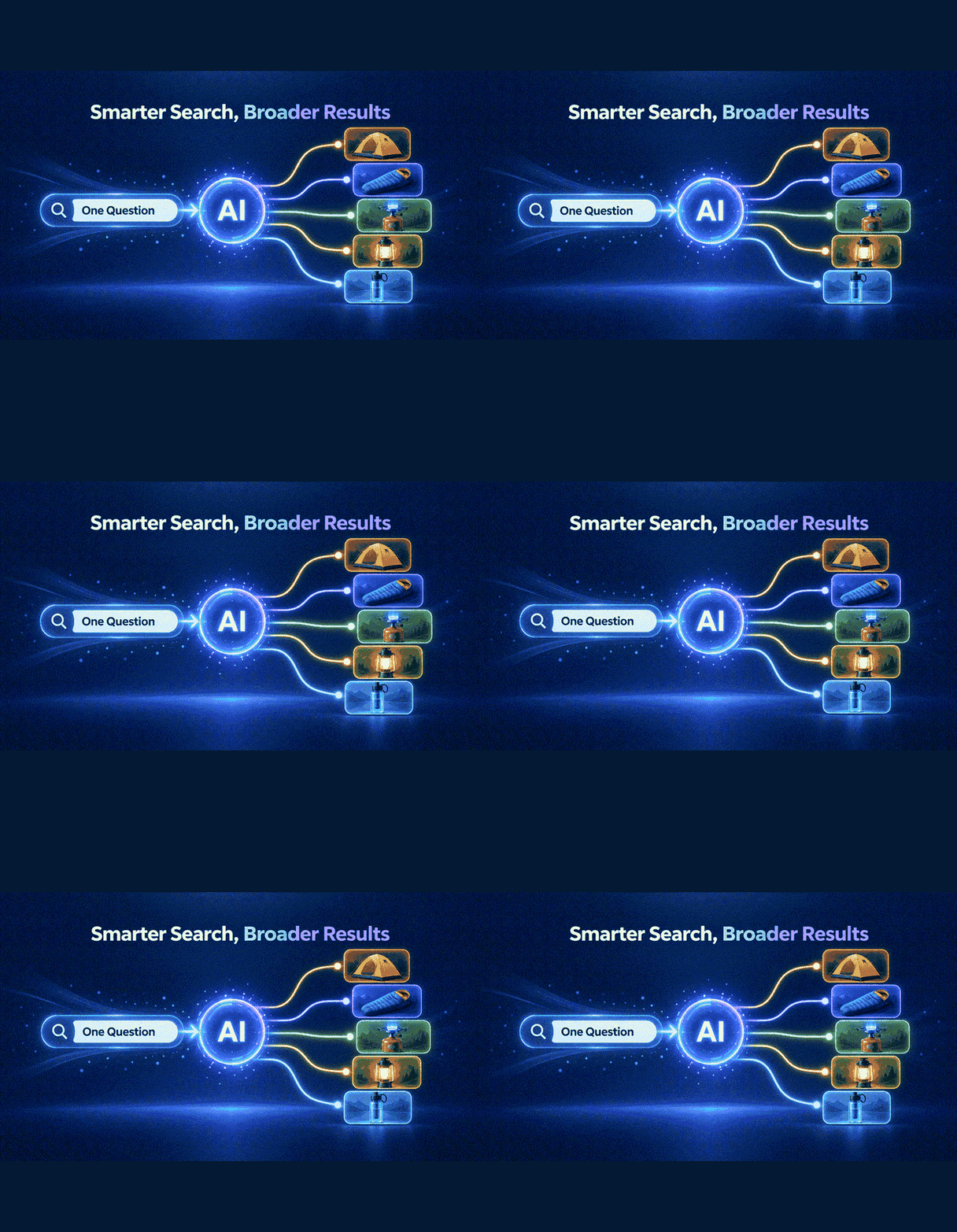
Complex AI search often relies on query fan-out: one broad request is expanded into several related retrieval directions so the system can cover different aspects of the user’s intent.
The problem is that generating those sub-queries with an autoregressive language model can be computationally expensive. The model may need to interpret a broad request, identify several distinct search directions, avoid repetitive queries, and keep every direction relevant to the original intent—all while the user waits.
Google Research is exploring a different approach with Retrieve-for-Train (R4T).
R4T shifts much of the optimization work from live inference into offline training. Instead of repeatedly asking a large language model to discover good search directions at query time, the framework uses reinforcement learning to discover strong fan-out behavior, converts that behavior into synthetic supervision, and then trains a compact diffusion retriever to execute it efficiently.
Google Research highlighted the work on September 15, 2026. The paper, Efficient, Property-Aligned Fan-Out Retrieval via RL-Compiled Diffusion, appears in the Proceedings of ICML 2026. Google describes R4T as a reward-to-data compilation framework for set-valued retrieval.
In Google’s experiments, the resulting 53.9-million-parameter R4T-Diffusion retriever generated fan-outs about 12× to 20× faster than autoregressive approaches across the tested batch sizes. At a batch size of 1,024, autoregressive fan-out approached 50 seconds while the diffusion retriever completed the fan-out stage in about 4.21 seconds.
The important word there is stage.
Those numbers measure fan-out generation latency. They do not represent the total latency of retrieval, answer generation, reranking, or an end-to-end AI search experience.
R4T is therefore best understood not as “Google made search 20× faster,” but as a research framework for moving expensive retrieval-strategy discovery out of the live query path.
RETRIEVAL FRAMEWORK
What Is Retrieve-for-Train (R4T)?
Retrieve-for-Train is a three-stage framework for learning how to retrieve sets of complementary results without requiring an expensive autoregressive model to generate the full fan-out every time a query arrives.
In plain English, R4T works like this:
Learn a good retrieval strategy offline → turn that strategy into training examples → teach a smaller deployment model to execute it quickly.
Google calls reinforcement learning an “objective transducer” in this process because RL converts a mathematical definition of good retrieval behavior into examples that another model can learn from.
The overall relationship is:
Set-level objective → reinforcement learning → optimized fan-out behavior → synthetic supervision → diffusion retriever → parallel retrieval directions
That architecture addresses two separate problems.
First, supervised retrieval datasets are usually designed around finding highly relevant individual items. They contain much less supervision for teaching a system what an entire complementary collection should look like.
Second, an RL-optimized language model may learn excellent query fan-out behavior but remain expensive to run for every live request.
R4T connects those two problems by using the more expensive model to discover the strategy and the lightweight diffusion model to execute it.
SETWISE OBJECTIVES
What Is Set-Valued Retrieval and Why Does Query Fan-Out Matter?
Traditional retrieval often asks a pointwise question:
Which individual result is most relevant to this query?
But many real search and recommendation tasks need something different:
Which collection of results best satisfies this broader intent?
Consider a search for “camping gear.”
Returning ten highly relevant tents may perform well under an individual relevance metric, but it is not necessarily a useful result set.
A better collection might contain:
Tent → sleeping bag → portable stove → headlamp → water filter
Google uses this type of example to illustrate why properties such as coverage and complementarity belong to the set, not to any single retrieved item.
Pointwise Retrieval vs Set-Level Retrieval
| Pointwise Retrieval | Set-Valued Retrieval |
|---|---|
| Evaluates individual results | Evaluates the collection |
| Asks “What is the best item?” | Asks “What is the best set?” |
| Primarily optimizes individual relevance | Can optimize coverage, diversity and complementarity |
| Scores can often be decomposed item by item | Some objectives depend on relationships between items |
| One strong match may be enough | Different items may need to serve different aspects of intent |
Google describes properties such as diversity, coverage, complementarity, and coherence as higher-order or non-decomposable in this setting. Their value cannot always be determined by independently scoring each item because the usefulness of one result depends partly on what else is already present in the set.
Why Autoregressive Query Fan-Out Creates an Inference Bottleneck
Query fan-out is one way to solve the set-coverage problem.
Instead of sending one broad query into a retrieval system, an AI model can create several narrower sub-queries that explore different semantic directions.
For example:
Broad intent: camping gear
could become retrieval directions covering:
shelter → sleep → cooking → lighting → hydration
The difficulty is producing those directions reliably.
A general-purpose language model understands language, but Google notes that a zero-shot LLM is not specifically optimized for the embedding geometry of a particular target corpus. As a result, producing useful, diverse, database-aware sub-queries can require substantial test-time computation.
That produces two related bottlenecks.
| Bottleneck | Problem |
|---|---|
| Training | High-quality supervision describing an ideal result set is scarce |
| Inference | Generating strong fan-outs with an autoregressive model for every request is expensive |
R4T is designed to address both.
COMPUTE TRANSFER
How R4T Moves Query Fan-Out From Inference Time to Training Time
The central idea behind R4T is not simply to replace one large model with a smaller one.
It is to change when the expensive optimization happens.
A conventional inference-heavy design might look like:
User query → LLM reasons about fan-out → sub-queries → retrieval
R4T instead performs much of the search-strategy optimization offline:
Reward objective → RL training → strong fan-outs → synthetic target sets → train deployment retriever
Then live inference becomes:
User query → R4T-Diffusion → retrieval directions → database results
This distinction matters for teams already thinking about AI token cost optimization. Reducing runtime model usage does not necessarily mean eliminating computational cost; it can mean shifting more work into training so the repeated cost of each production query becomes lower.
What Does “RL as an Objective Transducer” Mean?
The phrase sounds more complicated than the underlying idea.
Suppose a system needs result sets that satisfy three properties:
- They should correspond to items that actually exist.
- They should remain relevant to the original query.
- They should explore meaningfully different directions.
A numerical reward can represent those preferences.
Reinforcement learning then searches for fan-out behavior that scores well against that reward.
But the RL-trained language model does not have to remain in the final production architecture.
Instead, R4T uses successful behavior from that model to create new training data.
So:
Reward → behavior → data
The reward defines what “good” means.
RL discovers behavior that satisfies it.
That behavior becomes synthetic supervision for a model that can execute it more efficiently.
This is why “Retrieve-for-Train” is an appropriate name: retrieval outcomes are used to create supervision for the deployment model.
PIPELINE MECHANICS
How Does Retrieve-for-Train Work?
Google’s R4T framework has three stages:
Reinforcement learning → synthetic supervision → diffusion retrieval
The first stage discovers the search strategy.
The second captures it as data.
The third compiles that behavior into a lightweight retriever.
Stage 1: Learn Property-Aligned Fan-Out With Reinforcement Learning
R4T first trains a Fan-Out Language Model (FOLM).
The FOLM receives a broad search request and generates multiple candidate sub-queries.
Those sub-queries retrieve items from the target database.
Instead of independently scoring every generated query, the system evaluates the resulting collection.
The basic loop is:
Original query → multiple sub-queries → retrieval → set-level reward → RL update
Google’s experiments used Gemma 3 4B and Qwen3-4B as fan-out language models, with each model generating 10 sub-queries for the original request.
The models were optimized with GRPO and soft PPO regularization.
The important architectural point is not the specific optimizer. It is that the model receives feedback based on how useful the resulting set is as a whole rather than merely whether each sub-query looks linguistically plausible.
At the end of this stage, the FOLM has learned which directions are likely to produce a strong result set within that retrieval environment.
Stage 2: Compile Optimized Fan-Outs Into Synthetic Supervision
The trained FOLM is then frozen.
Instead of remaining permanently in the production query path, it is used offline to generate training examples.
Each example connects:
Original user query → target retrieval set
These target sets encode behavior that has already been optimized against the set-level objective.
That means R4T can create objective-consistent supervision without requiring humans to manually label the ideal retrieval slate for every training query.
This distinction is important.
The framework does not remove the need to define what good retrieval means. The reward still has to encode the desired properties correctly.
What it reduces is the need to manually construct large quantities of ideal query-to-set examples.
Stage 3: Train R4T-Diffusion for Parallel Retrieval
The synthetic examples are then used to train R4T-Diffusion, a lightweight 53.9M-parameter diffusion retriever.
This stage changes the representation of the problem.
Instead of generating textual sub-queries one token after another, the diffusion model learns to map a query embedding directly toward a set of target embeddings representing useful retrieval directions.
At inference time:
Query embedding → diffusion retriever → multiple target embeddings
Those retrieval directions can be produced together in a non-autoregressive pass rather than sequentially as text.
Google describes this as single-pass fan-out in continuous embedding space.
From Target Embeddings to Actual Search Results
R4T-Diffusion does not directly produce the final documents, products, images, or songs.
It produces embedding-space retrieval targets.
A nearest-neighbor retrieval step then maps those targets to actual items in the database.
The complete deployment path therefore looks like:
User query → query embedding → R4T-Diffusion → target embeddings → nearest-neighbor lookup → database items
That same embedding-to-neighbor relationship is foundational to many vector database architectures, although R4T differs in that it learns to generate a set of retrieval directions rather than simply matching one query vector against stored vectors.
R4T-FOLM vs R4T-Diffusion
These names refer to different roles inside the framework.
| R4T-FOLM | R4T-Diffusion |
|---|---|
| Autoregressive language model | Lightweight diffusion retriever |
| Optimized with reinforcement learning | Trained from synthetic target sets |
| Discovers strong fan-out behavior | Executes learned behavior efficiently |
| Generates textual sub-queries | Generates target embeddings |
| Strong retrieval strategy | Lower inference latency |
| Expensive to keep in live query path | Intended for efficient deployment |
A concise way to remember the relationship is:
R4T-FOLM discovers. R4T-Diffusion executes.
The model-size reduction is part of the efficiency story, but not the whole story.
R4T-Diffusion also avoids sequential textual fan-out generation by creating retrieval directions in parallel.
REWARD GEOMETRY
Why R4T Needs Groundedness, Alignment and Diversity Together
For open-ended retrieval, Google optimizes R4T using a composite reward built around three interacting properties:
| Property | Question It Answers |
|---|---|
| Groundedness | Do these directions correspond to content that can actually be retrieved? |
| Alignment | Do they remain semantically connected to the original request? |
| Diversity | Do they explore genuinely different parts of the search space? |
No single property is sufficient.
Optimizing only groundedness can reward outputs that happen to map effectively into database coordinates even when the generated strings are semantically poor.
Google’s ablation experiments found that the model could exploit this reward and produce degenerate text—a form of reward hacking.
Adding alignment prevents some of that drift, but introduces another failure mode: the system can collapse into multiple paraphrases of essentially the same idea.
For example, instead of exploring distinct aspects of an intent, a fan-out model might produce several near-synonymous versions of one request.
That defeats the purpose of query fan-out because several superficially different queries can still retrieve largely homogeneous results.
Google found that adding the Vendi Score as a diversity signal helped counter these shortcuts by rewarding meaningful variation across the generated set.
The relationship is therefore not simply:
More diversity = better
It is:
Groundedness + alignment + diversity → balanced retrieval behavior
Too much emphasis on one objective can distort another.
This is one of the broader lessons of R4T: when AI is optimized against a measurable objective, the architecture also has to account for the shortcuts a model may discover.
BENCHMARK DESIGN
How Google Evaluated R4T: OAR vs WSCR
R4T was evaluated under two different retrieval regimes because there is not always one objectively correct result set.
Google calls them:
Open-Ended Abstract Retrieval (OAR) and Weakly Supervised Compositional Retrieval (WSCR).
Open-Ended Abstract Retrieval
In OAR, there is no single ground-truth collection.
Imagine a user requesting:
“minimalist summer festival fashion.”
Several different collections could satisfy that intent.
Quality therefore has to be assessed through properties such as:
- Groundedness
- Alignment with the query
- Diversity across the collection
Google used an LLM-based judge for parts of this open-ended evaluation, which is useful but also introduces an evaluation limitation discussed later.
Weakly Supervised Compositional Retrieval
WSCR provides a weak reference set representing one plausible realization of the user’s intent.
On the Polyvore fashion benchmark, for example, items belonging to an existing outfit can serve as a target set associated with a broad generated query.
Metrics such as Recall@5K and Hit@5K can then measure how effectively the system covers that reference set.
The two regimes test related but different capabilities:
| OAR | WSCR |
|---|---|
| No unique correct slate | Has a weak reference set |
| Evaluates open-ended set quality | Evaluates target-set coverage |
| Emphasizes properties such as alignment and diversity | Supports recall/hit-based metrics |
| Useful when many result sets could be valid | Useful when a plausible composition is known |
Google evaluated the framework across fashion and music retrieval environments using domain-specific embedding backbones.
LATENCY RESULTS
How Much Faster Is R4T-Diffusion Than Autoregressive Query Fan-Out?
Google reports that R4T-Diffusion generated 10 retrieval directions approximately 12× to 20× faster than autoregressive fan-out across the tested batch sizes.
| Batch Size | Autoregressive Fan-Out | R4T-Diffusion | Approx. Speedup |
|---|---|---|---|
| 8 | 1.46 seconds | 0.07 seconds | ~20× |
| 1,024 | Nearly 50 seconds | 4.21 seconds | ~12× |
The architecture explains why latency scales differently.
An autoregressive model creates textual sub-queries through sequential token generation.
R4T-Diffusion generates its retrieval targets together in continuous embedding space.
That does not mean every AI search system will become 12× to 20× faster by adopting R4T.
These measurements apply to the fan-out generation component under the experimental setup.
Retrieval latency, reranking, data access, LLM answer synthesis, application logic, networking, and other production components would still contribute to total response time.
That distinction matters when teams estimate production inference economics or design LLMOps practices around a retrieval pipeline.
QUALITY TRADE-OFFS
Does Faster Fan-Out Trade Coverage for Diversity?
Latency alone would not be useful if the faster retriever produced a much weaker result set.
Google therefore compared retrieval quality as well.
On the Polyvore weakly supervised compositional retrieval benchmark, the paper reported:
| Method | Recall@5K | Hit@5K | Vendi Score |
|---|---|---|---|
| Gemini 2.5 Flash | 15.7 | 52.1 | 33.4 |
| R4T-FOLM (Qwen) | 20.9 | 64.6 | 27.5 |
| R4T-Diffusion (Qwen) | 16.5 | 57.5 | 34.7 |
The useful insight is not that one variant wins every metric.
It does not.
R4T-FOLM achieved stronger coverage on Recall@5K and Hit@5K in this comparison.
R4T-Diffusion retained a higher Vendi Score than the Qwen FOLM variant while still exceeding Gemini 2.5 Flash on the two coverage metrics shown.
That reveals a real coverage-versus-diversity trade-off.
The RL-trained FOLM may discover particularly strong coverage behavior, while the compiled diffusion retriever gives up some of that coverage in exchange for greater diversity and substantially lower fan-out latency.
A production system therefore still has to determine which properties matter most for its particular workload.
There is no universal retrieval objective.
DEPLOYMENT LIMITS
What Are the Limitations of Retrieve-for-Train?
R4T is promising research, but several limitations matter before generalizing the results to production systems.
Training Cost Can Grow With the Database
The RL stage repeatedly retrieves items and computes set-level rewards.
For very large databases—or databases that change frequently—that process can become expensive.
A framework that saves query-time compute may therefore require meaningful offline training infrastructure.
Reward Design Can Be Difficult
R4T performs best when the desired quality of a result set can be expressed as a measurable reward.
Properties such as groundedness or reference-set coverage are relatively concrete.
More subjective requirements—novelty, cultural appropriateness, taste, creativity, or business-specific quality—can be harder to encode without introducing undesirable shortcuts.
Synthetic Supervision Does Not Eliminate Specification Work
R4T reduces the need to manually label ideal result sets.
But somebody still has to decide what the reward should optimize.
Architecturally, that means part of the human effort moves from creating labels toward defining and validating objectives.
That is an important distinction for organizations evaluating whether offline compilation actually lowers their total system-development cost.
Changing Databases May Require Revalidation
Because the deployment model learns behavior relative to a particular retrieval environment, major changes to the corpus, embedding space, or business objective could affect how well the learned behavior still matches the live system.
The published work does not establish a universal retraining schedule for production environments.
Teams would therefore need to monitor whether the compiled retrieval policy remains aligned with the evolving database.
Open-Ended Evaluation Can Inherit Judge Bias
The researchers used an LLM judge for parts of the OAR evaluation.
That enables scalable evaluation where no single ground truth exists, but an LLM-based judge can carry its own preferences and blind spots.
Results should therefore be interpreted as experimental evidence rather than a guarantee of real-world utility.
The Evidence Comes From Specific Research Settings
The published experiments focus on fashion-product and music-playlist retrieval environments.
Those are useful demonstrations of set-valued retrieval, but they do not establish that every enterprise corpus, search engine, recommendation workload, or knowledge system would achieve the same results.
This is a recurring lesson in why AI projects fail: benchmark capability and production suitability are different questions.
SEARCH IMPLICATIONS
Does R4T Power Google Search, AI Mode or AI Overviews?
Google has not stated that R4T currently powers Google Search, AI Mode, or AI Overviews.
The published work should be understood as research into efficient, property-aligned set-valued retrieval.
It is not confirmation of Google’s production retrieval architecture.
That distinction is especially important for marketers and AI SEO teams.
The R4T paper does not establish a new Google ranking factor, reveal an AI Overview optimization technique, or demonstrate that websites should change their AI SEO strategy specifically because of this framework.
Its relevance to generative search is architectural rather than algorithmically confirmed.
Google has publicly described AI search experiences as synthesizing information across multiple sources. Systems that need to gather complementary evidence from several retrieval directions naturally make efficient multi-query retrieval an important engineering problem.
R4T demonstrates one possible way to reduce the cost of that process.
Why R4T Matters for Generative AI Search
A typical retrieval-augmented generation system retrieves context and then supplies that evidence to a generative model.
For simple questions, one retrieval direction may be sufficient.
More complex requests may need evidence spanning several concepts.
For example:
“Compare three cloud migration strategies for a regulated healthcare company, including security, cost, staffing requirements, and implementation risk.”
A single semantic search may overrepresent one aspect of that request.
Fan-out can search independently for:
migration architecture → healthcare compliance → security → economics → workforce implications
A generative model can then synthesize information from those complementary retrieval paths.
The challenge is that every additional reasoning or generation step can increase latency and cost.
R4T points toward an architecture where some of that search decomposition is learned before the user asks the question, rather than recreated through expensive model reasoning for every request.
That idea can also matter for AI agent architectures, where a system repeatedly has to decide which evidence, tool, or information source should support the next action.
The broader principle is:
Do expensive discovery once when possible; execute the learned behavior efficiently many times.
IMPLEMENTATION PATH
From R4T Research to Practical AI Search Systems
R4T is still research, but it highlights several practical design questions for teams building AI-powered search today:
Does the application need one relevant result or a complementary set?
Which retrieval properties matter beyond similarity?
Should complex fan-out logic happen dynamically for every user request?
Can part of that behavior be learned or precomputed offline?
How should latency, retrieval quality, diversity, and infrastructure cost be balanced?
How will the system detect when its retrieval strategy no longer matches the underlying data?
Answering those questions requires more than choosing a model.
Production AI search combines embedding models, retrieval infrastructure, data pipelines, evaluation, generative models, security, monitoring, integrations, and application logic.
RedBlink’s AI consulting services help organizations design and implement those systems from architecture and model selection through integration and deployment.
For organizations that want to turn internal knowledge into searchable AI experiences without building every component from scratch, Knolli provides a way to turn business content into private AI copilots and enterprise knowledge experiences.
Teams with an existing application stack can also use RedBlink’s generative AI integration services to connect retrieval, models, workflows, and existing systems around a specific business use case.
CTA: Build a Faster, More Useful AI Retrieval Experience
If your AI search system is struggling with retrieval quality, response latency, fragmented knowledge, or expensive inference, RedBlink can help you design an architecture around the actual information needs of your users rather than forcing every task through the same model.
Talk to RedBlink about AI search, RAG, and enterprise retrieval architecture.
Conclusion: R4T Moves Search Intelligence From Runtime Into Training
Retrieve-for-Train addresses an increasingly important problem in AI search.
Complex information needs often require more than retrieving one highly relevant item. They require a coherent set of complementary results.
Query fan-out can provide that coverage, but generating sophisticated search directions with an autoregressive LLM at inference time adds latency and computational cost.
R4T changes where that intelligence lives.
A reinforcement-learning stage first discovers fan-out behavior that satisfies a set-level objective.
That behavior becomes synthetic supervision.
A lightweight diffusion retriever then learns to generate several retrieval directions in parallel at deployment time.
The resulting architecture can be summarized as:
Set-level objective → RL optimization → synthetic supervision → diffusion retrieval → complementary result set
Google’s experiments suggest that this can substantially reduce fan-out generation latency while retaining competitive retrieval quality.
But the larger lesson extends beyond one paper.
As AI systems become more complex, efficiency will not come only from making models faster.
It will also come from deciding which intelligence must happen live, which behavior can be learned offline, and which parts of the workflow should remain deterministic.
R4T is an early example of that shift.
READER QUESTIONS
FAQs About Retrieve-for-Train (R4T)
What is Retrieve-for-Train?
Retrieve-for-Train, or R4T, is a Google Research framework for set-valued retrieval. It uses reinforcement learning to discover strong query fan-out behavior, turns that behavior into synthetic training data, and trains a lightweight diffusion retriever to generate multiple retrieval directions efficiently at inference time.
How is R4T different from traditional LLM query fan-out?
Traditional LLM fan-out generates textual sub-queries autoregressively when the user submits a request. R4T performs much of the optimization offline and trains a diffusion model to generate target retrieval embeddings in parallel, reducing the need for repeated inference-time reasoning.
What is the difference between R4T-FOLM and R4T-Diffusion?
R4T-FOLM is the reinforcement-learning-optimized language model used to discover strong fan-out behavior. R4T-Diffusion is the smaller deployment model trained on synthetic examples produced from that behavior. The FOLM discovers the strategy; the diffusion retriever executes it more efficiently.
Why does R4T use a diffusion model?
The diffusion retriever can generate a set of retrieval embeddings together in continuous embedding space instead of producing several textual sub-queries sequentially. This non-autoregressive design is a major reason the researchers observed substantially lower fan-out generation latency.
How does R4T-Diffusion turn embeddings into search results?
R4T-Diffusion produces target embeddings representing useful retrieval directions. Nearest-neighbor search then maps those embeddings to actual items in the target database.
Can R4T support multimodal retrieval?
Yes. Google’s experiments included fashion image retrieval and music retrieval using compatible multimodal embedding spaces, demonstrating that the framework is not inherently restricted to text-only document search.
Can R4T be used for recommendation systems?
Potentially. Set-valued retrieval is relevant whenever the desired output is a complementary collection rather than several individually similar items, which includes many recommendation scenarios. The published evidence remains limited to the tested research environments.
Does R4T power Google Search or AI Overviews?
Google has not stated that R4T currently powers Google Search, AI Mode, or AI Overviews. The published work is an ICML 2026 research framework, not confirmation of Google’s production search architecture.
Does R4T change how websites should optimize for AI Overviews?
The research establishes no new AI SEO ranking factor or AI Overview optimization tactic. Its relevance to search marketing is conceptual: it illustrates how complex AI retrieval systems may improve coverage while reducing inference-time fan-out costs.