
Last Updated on June 12, 2026
What if your AI is confidently wrong, not because the model hallucinated, but because the retrieval layer failed to find the truth?
In 2026, this “hidden failure” is the primary bottleneck for enterprise AI. While Retrieval-Augmented Generation (RAG) is the standard for grounding LLMs, vector-only search is hitting a structural ceiling.
Gartner reports that 38% of AI project failures are now directly caused by poor data quality or limited data availability, affecting AI and RAG implementations broadly (Source).
Official research indicates that while traditional vector RAG struggles with complex entity relationships, GraphRAG provides substantial improvements in reasoning and synthesizing insights across disparate data sources (Source).
The demand for structured grounding is surging; the enterprise knowledge graph market is projected to reach $13.3 billion by 2033, as organizations prioritize interconnected data over simple similarity search (Source).
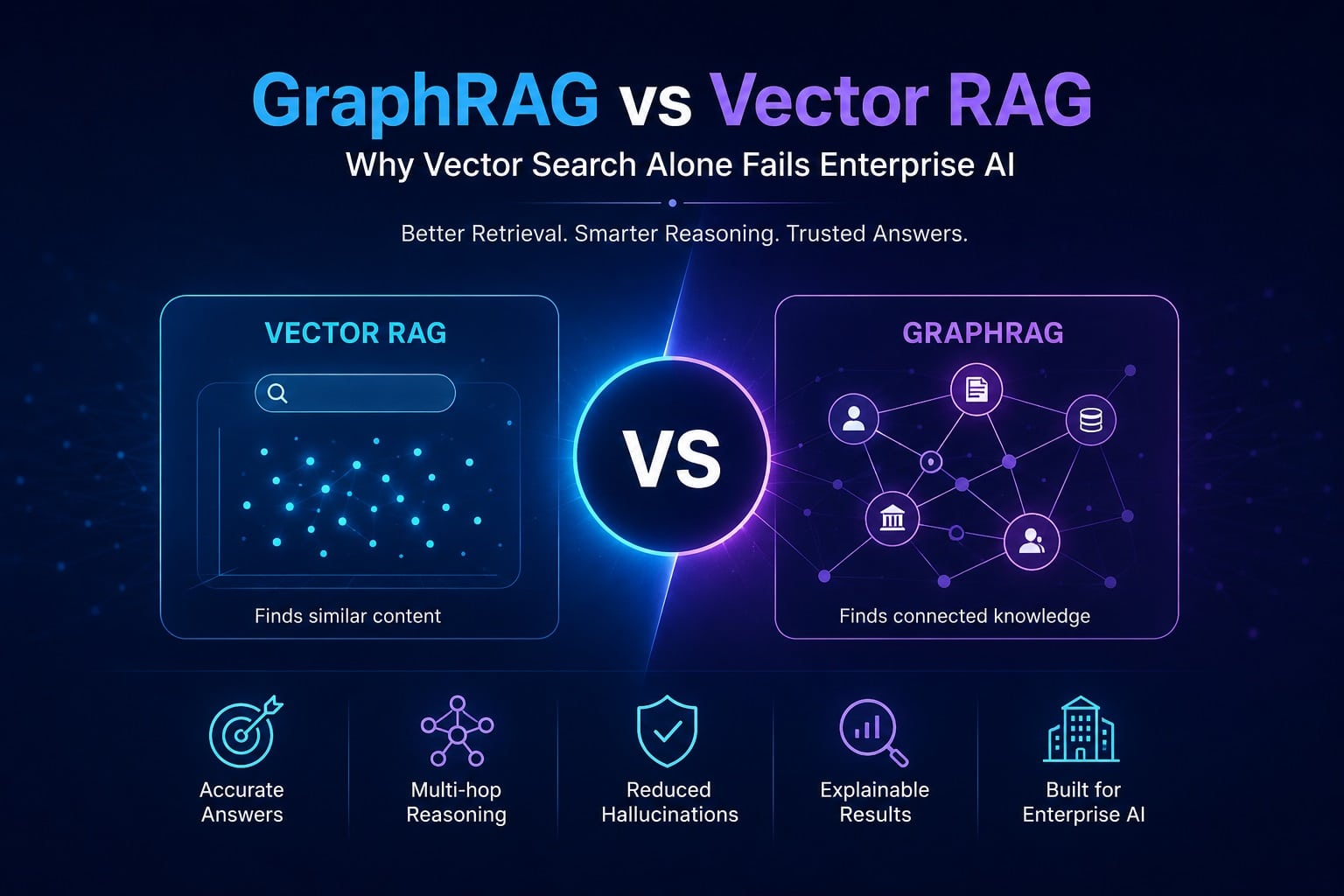
Vector search finds “similar” text, but GraphRAG maps “connected” logic. For enterprises handling fragmented data, the move from similarity to connectivity isn’t just an upgrade; it’s a requirement for survival.
The Core Problem: Vector Search Captures Similarity, Not Structure
The standard RAG pipeline is well understood: chunk documents, embed them into a vector database, retrieve the top-k results by cosine similarity, and pass them to an LLM as context. For unstructured semantic search, finding documents that are topically similar to a query, this works well.
Enterprise knowledge, however, is rarely just a collection of similar documents. It is a web of interconnected entities, dependencies, hierarchies, and relationships. A supply chain has components that depend on suppliers tied to contracts with SLA clauses. A financial compliance system has regulations that reference other regulations, exceptions, and jurisdictional carve-outs. A healthcare record system connects patients, diagnoses, medications, interactions, and protocols.
When a user asks a question that requires reasoning across those relationships, “How will the delay in Component X impact our Q3 deliverable for Client Y?”, a vector store cannot answer it reliably. It can retrieve chunks that semantically resemble the query. But it has no model of the fact that Component X feeds into Client Y’s supply chain, or that Client Y’s contract has a specific penalty clause that activates under delay conditions.
The LLM receives plausible-looking context and does its best. The result is a confident, coherent, and subtly wrong answer.
| Key Research Finding: A 2026 arXiv study from Xiamen University and Hong Kong Polytechnic University found that while graph retrieval improves reasoning depth by 4.5% on multi-hop question benchmarks (HotpotQA), it comes with a 2.3x higher average latency. The tradeoff is real and worth understanding before you build. |
What Graph-Enhanced RAG Does Differently and Why It Matters?
A knowledge graph doesn’t store text. It stores entities and the relationships between them. Instead of retrieving “chunks that look like the query,” a graph-enhanced RAG system can traverse the actual structure of your knowledge: find the entity, follow the edges, and return the facts that are structurally connected to the question.
This enables a fundamentally different class of queries:
- Multi-hop reasoning: Questions where the answer requires connecting two or more facts across different documents or data sources
- Entity-centric queries: “Which customers are affected by services that depend on Component X?”, queries that require traversing a dependency graph
- Cross-document synthesis: Drawing connections across policies, contracts, incident tickets, and architecture notes simultaneously
- Global thematic questions: “What are the recurring root causes across our incident reports this year?”, questions that require synthesising patterns across an entire dataset
- Explainable retrieval: Retrieved subgraphs show exactly which entities and relationships grounded the answer, critical for compliance and audit requirements
That last point, explainability, is increasingly a hard requirement in regulated industries. Vector search returns results; it cannot show you the reasoning path. A graph traversal can.
Vector RAG vs. Graph-Enhanced RAG: A Direct Comparison
Not all retrieval architectures are built for the same problems. Vector RAG excels at finding semantically similar content fast, but when your queries involve relationships, dependencies, and multi-step reasoning, the gaps become hard to ignore. Here’s how the two approaches stack up across the dimensions that matter most in production.
| Dimension | Vector-Only RAG | Graph-Enhanced RAG |
|---|---|---|
| Retrieval method | Cosine similarity (nearest-neighbour) | Graph traversal + semantic search combined |
| Multi-hop reasoning | No, misses cross-document relationships | Yes, traverses entity-relationship chains |
| Explainability | No, returns chunks, no reasoning path | Yes, subgraphs show the exact reasoning path |
| Schema-bound queries | No, 0% accuracy on structured KPI queries in benchmarks* | Yes, 90%+ accuracy on the same benchmark queries* |
| Retrieval latency | Yes, 50–100ms | No, 200–500ms (mitigated by caching) |
| Setup complexity | Yes, low; embed and query | No, entity modelling, graph maintenance |
| Hallucination risk | Higher on relational queries | Lower, grounded in structured facts |
| Best for | Semantic search, unstructured text | Interconnected data, compliance, supply chain |
| Note: the low-vs-significantly-higher-accuracy comparison refers specifically to schema-bound structured KPI queries in the FalkorDB benchmark. Vector RAG may perform adequately on unstructured semantic search tasks. |
3 Production Architectural Patterns for Graph-Enhanced RAG
Teams implementing graph-enhanced RAG in production typically converge on one of three patterns, depending on data complexity and query type. Choosing the right pattern before building is one of the most important decisions you’ll make.
Pattern 1: Parallel Retrieval and Merge
Run vector search and graph traversal simultaneously. Merge and rerank the results before passing context to the LLM. This gives you semantic breadth from the vector store and structural depth from the graph. It is the most common entry point and the lowest-risk migration from a pure vector architecture. Well-suited for teams that have an established vector pipeline and want to add graph capabilities incrementally without a full rebuild.
Pattern 2: Graph-Guided Vector Retrieval
Use the knowledge graph to pre-filter and constrain the vector search. The graph provides structural context that determines which document chunks are even candidates for retrieval before the embedding similarity is calculated. This approach shows that the graph can discipline the vector search, improving precision without the full latency overhead of deep graph traversal. Best for domains where your entity model is well defined, and your queries are structured around specific entities.
Pattern 3: Community Summarisation (Global Queries)
Cluster entities in the graph into communities based on structural relationships. Generate summaries of each community during indexing. At query time, use community summaries rather than raw document chunks to answer holistic questions. This is particularly powerful for strategic queries, trend analysis, root cause detection, and pattern identification, where the answer is distributed across thousands of documents, and no single chunk holds the full picture. It is also the most computationally expensive pattern to build and maintain.
| Latency Management: Graph traversal runs at 200–500ms for vector-only retrieval (Source). The standard production mitigation is semantic caching: if an incoming query is sufficiently similar to a previous query, serve the cached graph result. For enterprise knowledge retrieval, where queries cluster around common themes, this significantly reduces the effective latency gap. |
5 Clear Signals You’ve Outgrown Vector-Only RAG
Graph-enhanced RAG is not a universal upgrade. Adding a knowledge graph to a system that doesn’t need one introduces complexity without a corresponding benefit. The clearest signals that you’ve outgrown vector-only retrieval:
- Your LLM performs reliably on simple factual queries but is consistently unreliable on anything requiring two or more logical steps
- Users are asking entity-relationship questions your system cannot answer correctly: “Who is responsible for X?”, “What depends on Y?”, “How does Z affect our Q3 numbers?”
- You operate in a regulated environment where audit trails and explainable reasoning paths are a compliance requirement, not a nice-to-have
- Your domain has structured hierarchies, org charts, supply chains, regulatory frameworks, and product dependency trees that a flat vector store cannot represent
- Hallucination rates are acceptable on isolated facts, but spike on queries that require synthesising information from multiple sources
A Practical Graph RAG Migration Roadmap (Without Replacing Your Stack)
The good news: successful migration does not require replacing your existing vector infrastructure. The 2026–2026 practitioner consensus is to layer graph capabilities on top of what you already have, not rebuild from scratch.
- Instrument before you change anything: Add observability to your existing RAG pipeline. Track which retrieval results the LLM actually uses versus ignores. Log recall and precision by query type. Identify the specific failure patterns, multi-hop questions, entity-relationship queries, and cross-document synthesis. You cannot fix what you cannot measure, and the data will tell you which pattern to implement.
- Define your entity model first: The most common Graph RAG failure in production is teams that choose a graph database first and define the knowledge schema as an afterthought. Your entity model, what counts as a node, what counts as an edge, and how relationships are classified, is the intellectual core of the system. It requires domain expertise, not just engineering. Get it right before writing code.
- Start with a hybrid baseline: Add graph retrieval specifically for the query types where vector search is provably failing. Keep vector search for everything else. Run both in parallel. Measure the improvement before expanding the graph’s scope.
- Choose your graph tooling: Production-ready options as of 2026 include Microsoft GraphRAG (strong for community summarisation), Neo4j with LLM integrations (mature ecosystem), FalkorDB (optimised for low-latency graph queries), and Amazon Neptune Analytics (AWS-native, managed). Tool choice should follow entity model and query pattern requirements, not the other way around.
- Build graph maintenance into your operational model: Knowledge graphs are living systems. Entities change, relationships evolve, and domain taxonomies expand. Entity update pipelines and graph quality monitoring are not optional; they are operational requirements that need to be planned before go-live, not retrofitted after.
Conclusion: Where Enterprise AI Retrieval Is Heading in 2026 and Beyond?
Graph-enhanced RAG is not an experimental pattern. It is the direction the enterprise AI retrieval landscape is moving, driven by the practical limits of semantic similarity at scale.
The 2026–2026 window is a strategic moment: graph RAG tooling, Microsoft GraphRAG, FalkorDB, Neo4j, Amazon Neptune Analytics, has matured to the point of genuine production readiness, but it has not yet become commoditised. Teams that move now build a meaningful architectural advantage. Teams that wait will retrofit under pressure, explaining predictable failures.
Vector search has gotten most RAG systems to where they are today. For enterprise environments where the knowledge is structured, interconnected, and compliance-sensitive, it will not be enough to get them to where they need to go.
The retrieval layer is where enterprise AI wins or loses. Getting it right is no longer an implementation detail; it is a strategic decision.
If you’re ready to go beyond vector-only retrieval and build a production-grade, graph-enhanced RAG architecture, RedBlink’s knolli.ai platform is already built for teams that need connected data, advanced knowledge management, and explainable AI.
For custom GraphRAG implementations or enterprise AI development, RedBlink Technologies offers end-to-end AI consulting and development services, from strategy to deployment. Reach out at info@redblink.com to discuss your specific use case.
Frequently Asked Questions
What is the difference between RAG and Graph-Enhanced RAG?
Standard RAG retrieves documents by semantic similarity using vector embeddings. Graph-enhanced RAG adds a knowledge graph layer that models entities and relationships, enabling multi-hop reasoning, cross-document synthesis, and explainable retrieval paths, capabilities that vector search cannot provide.
Do I need to replace my vector database?
No. The recommended approach is to layer graph retrieval on top of your existing vector infrastructure. Most production systems run both in parallel, routing queries to the appropriate retrieval method based on query type and complexity.
Which industries benefit most from Graph-Enhanced RAG?
Any domain with highly interconnected data: financial services (compliance, fraud detection), supply chain, healthcare (clinical pathways, drug interactions), legal (cross-referencing regulations), and enterprise IT (system dependency mapping and incident root cause analysis).
What tooling is available for production Graph RAG?
Mature options as of 2026 include Microsoft GraphRAG, Neo4j with LLM integrations, FalkorDB (low-latency optimised), and Amazon Neptune Analytics. Tool selection should follow your entity model and query requirements.
How large does my knowledge graph need to be?
It depends entirely on your domain and query patterns, not raw document count. A precisely defined entity model covering a narrow domain will outperform a sprawling graph with poor schema discipline. Start narrow, measure, and expand deliberately.